Imagine More from Less: Transform Your Houseboat with Convertible Multiuse Spaces — Make Every Square Foot Work Harder and Live Larger
Attention: You love the water, but you don’t love sacrificing comfort for space. Interest: What if a single corner of your cabin could be a cozy lounge at noon, a convivial dining booth by evening, and a comfortable double bed by night — without drama or heavy lifting? Desire: Convertible Multiuse Spaces let you do exactly that. Action: Read on and you’ll get practical design rules, clever storage hacks, hardware choices, and a full DIY plan to build a convertible dining/sleeping booth that actually works on a real boat.
Before diving into detailed plans and hardware choices, consider a few curated resources that expand on layout thinking and outdoor adaptations for houseboats.
To help you visualize practical layouts and pull inspiration for finish choices, check out the broader design resources on our site. For an overview of schematic plans and clever space-saving approaches, see Houseboat Design Ideas, which lays out foundational concepts. For adaptable interior arrangements and communal flow, take a look at our piece on Open Plan Living Areas, and if you want to expand living zones outdoors, explore strategies for usable outdoor decks in Roof Deck Spaces, where convertible thinking extends above deck.
Design Principles for Convertible Multiuse Spaces on a Houseboat
Good design starts before a board is cut. When you’re designing Convertible Multiuse Spaces for a houseboat, think behavior first — how you’ll use the space — then structure, materials, and safety. Below are the principles that keep conversions smooth, safe, and reliable.
Start with the activity flow
Observe your daily rhythm. Where do you prep food, sip coffee, read, work, or sleep? Place multiuse zones where activities naturally overlap: a breakfast nook near the galley, a bench under a skylight for napping, or a table that doubles as a workstation and dining surface. Mapping flow prevents awkward conversions that block the galley or create pinch points.
Respect weight and center of gravity
Everything on board affects trim. Keep heavy components low and centered. Store dense items symmetrically across the beam. If you plan big built-ins or water tanks in a new layout, get a stability check from a marine pro — a small shift fore/aft can surprise you when fuel or water tanks run low.
Prioritize secure locking and simple operation
Convertible furniture must be locked for travel and easy to change when at rest. Use positive latches, pins, or locking gas struts. Make sure conversions can be done by one person if possible — two is fine, but solo-friendly designs get used more.
Keep conversions fast and reversible
If it’s fiddly, you’ll avoid converting it. Aim for one-handed latches, hinged lids with gas struts, removable but storable table pedestals, and cushions that attach with Velcro. The easier the action, the more often you’ll actually enjoy the space.
Design for daylight and ventilation
Convertible sleeping zones need airflow and privacy. Position them near operable portlights or hatches and ensure shading options for daytime naps and night privacy. Natural light also makes small spaces feel larger and more pleasant when used as living zones.
From Daybed to Dining: Creating Functional Convertible Living Zones
Let’s walk through the most reliable layouts for turning seating into sleeping, tables into beds, and everyday uses into restful retreats.
Banquette/Dinette that converts to bed
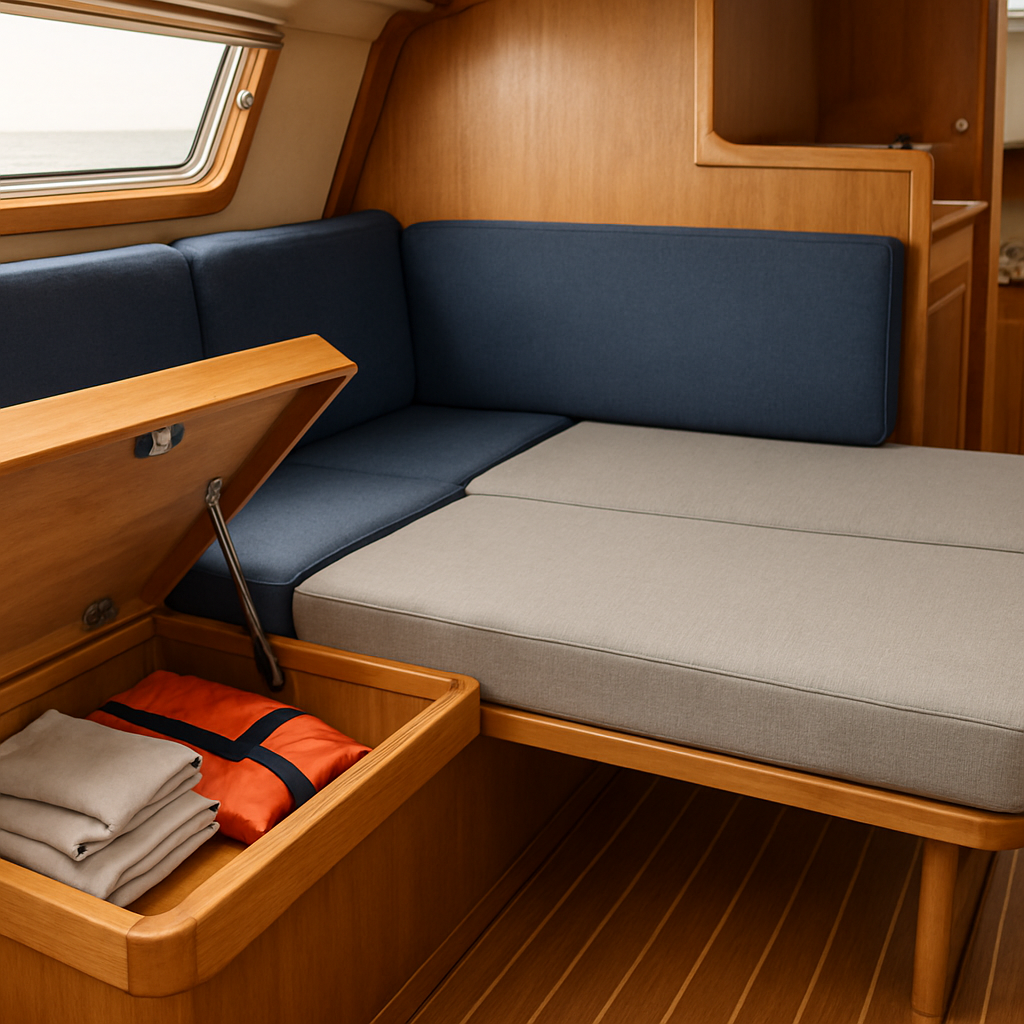
A built-in banquette with a hinged seat, a drop-in table top, and cushions that flatten makes one of the most traditional Convertible Multiuse Spaces. This design is efficient: the bench seat hides storage under the lid and the table drops into a pocket to form the mattress base.
Design notes: keep seat depth at 80–90 cm if you want a decent sleeping depth; narrow spaces can still work with firmer cushions and strategic head-to-foot orientation.
Murphy and fold-down beds adapted for boats
Murphy beds can be adapted to marine cabins, especially horizontal pivot models that fold into a sofa back or cabinet. Use marine-rated torsion springs or gas struts sized for the bed weight and add positive locks. Be mindful of overhead clearances and how the bed interacts with bulkheads and hatches.
Modular seating and cube systems
Modular cubes, ottomans, and stacking benches give enormous flexibility. Need a sofa? Arrange them. Need a bed? Slide them together, lay a mattress topper, and you’re set. Each module can contain storage and be light enough to stow or reposition.
Convertible tables and pedestals
Table designs that telescope, collapse, or fold down are golden. A two-stage pedestal with a removable center leg and folding leaves can convert a small workstation into a family dining table. Ensure pedestal sockets are robust and have non-skid or locking features to prevent lateral movement when the boat heels.
- Minimum sleeping width for single: 75–80 cm; for double: 120–140 cm, depending on comfort expectations.
- Allow 60–90 cm clearance at the table for seating/movement.
- Cushion thickness for bed comfort: 40–60 mm of firm foam with a softer topper as needed.
Smart Storage Solutions for Convertible Spaces Aboard a Boat
Storage makes or breaks a convertible design. The trick is to make storage part of the furniture’s structure — not an afterthought.
Under-seat compartments
Hinged lids with gas struts and internal dividers turn bench seats into closets for linens, life jackets, or pots. Include drains or raised rails inside to avoid water pooling and consider removable liners that can be cleaned or aired out.
Dual-purpose steps and pedestals
Step units to raised areas can hide shallow drawers perfect for socks, tools, or chargers. Pedestal bases are natural locations for pry-open lockers or slide-out baskets.
Vertical and hidden storage
Thin vertical lockers use otherwise wasted wall space. Flip-down panels above benches can hide books, plates, or kids’ toys. When underway, secure these with latches so nothing becomes a projectile.
Sealed and ventilated lockers
Use ventilated locker doors or mesh panels for clothes and linens to minimize mildew. For electronics and valuables, choose gasketed, sealed compartments and add a desiccant. A small 12V fan in a larger locker can dramatically reduce moisture.
Accessibility and ergonomics
Put frequently used items where your hand naturally reaches during a conversion. Label compartments, use transparent or color-coded bins, and avoid stuffing things so deep you need a crowbar to retrieve them.
Mechanisms and Materials: Making Furniture that Converts Seamlessly
Mechanics and materials decide whether your Convertible Multiuse Spaces feel like a well-engineered tool or a frustrating riddle. Choose hardware and materials made for marine conditions, and size mechanisms to the actual loads they’ll see.
| Mechanism / Material | Why use it | Notes |
|---|---|---|
| 316 stainless steel hinges & fasteners | Corrosion resistance in salt air | Use through-bolts with backing plates for strength |
| Marine-grade gas struts | Controlled opening/closing; holds lids open | Specify correct length and force with final cushion weight |
| Marine plywood + epoxy sealing | Strong base for cabinetry; resists rot when sealed | Seal all edges and fastener holes to prevent moisture ingress |
| Aluminum extrusions & frames | Lightweight, strong | Watch for galvanic isolation when bolting to steel or bronze |
Hardware selection tips
- Always favor 316 stainless or suitably coated hardware in exposed areas.
- Use threaded inserts in plywood for hardware that may be removed or replaced; it prevents stripping.
- For friction hinges, provide a secondary pin or latch; friction alone can fail in prolonged use or become slippery when wet.
- Size gas struts conservatively — account for cushion weight, moist fabric, and any added top layers.
Material finishes and upholstery
Choose closed-cell or quick-dry foam for cushions. Top with marine fabrics that resist UV, mold, and staining. For work surfaces, high-pressure laminate, teak veneer, or epoxy-coated plywood edges provide durability. Always pre-finish panels outside the boat when possible to avoid drips and save time.
Lighting, Ventilation, and Comfort in Convertible Layouts
Functionality isn’t just about shape; it’s about atmosphere and air. Your Convertible Multiuse Spaces should be well-lit, well-ventilated, and thermally comfortable in all their configurations.
Layered lighting for multiple moods
Use a three-layer approach: ambient (recessed LEDs, strip lights), task (under-cabinet or table lights), and accent (reading lamps or dimmable corners). Dimmable LEDs let you switch quickly from bright cooking light to soft pre-sleep glow. Small adjustable fixtures close to the bed are a big comfort win.
Ventilation for sleep and cooking
Cross-ventilation cuts condensation and keeps sleeping spaces fresh. Aim for an operable hatch or port near any convertible berth and another opening on the opposite side for airflow. For frequent cooking, a quiet 12V extractor will reduce lingering odors that otherwise settle into cushions.
Heating, cooling, and insulation
Insulation behind panels and under platforms helps keep temperatures steady. For cooler climates, a compact diesel or electric heater with safe exhaust routing is invaluable. In warmer spots, a small reverse-cycle unit or well-placed fans can keep sleeping zones comfortable without taking up excessive power.
Step-by-Step: Building a DIY Convertible Dining/Sleeping Booth
This complete DIY guides you through building a dinette that converts to a roughly 120 x 200 cm sleeping area (adjust to your hull width). It’s practical, uses common materials, and is tuned for marine use.
Estimated materials & tools
- Materials: 18mm marine plywood for bases, 12mm for facings, teak or HPL for tops, 2 gas struts (marine-grade), 316 SS piano hinge, threaded inserts, 316 SS fasteners, 2-piece folding table top, removable pedestal, closed-cell foam (40–50 mm), marine upholstery fabric, epoxy resin, wood glue, compression latches, small latch pins, sealant tape.
- Tools: circular saw or table saw, jigsaw, router with roundover bit, drill/driver, countersink, clamps, sander, staple gun, measuring tape, carpenter’s square, file, bench plane, caulking gun.
Mock-up and planning
Start with a full-scale cardboard mock-up inside the boat. Lay out the benches, table pedestal, and bed panels. Sit, imagine converting, and convert. This sanity-check saves time and regret. Measure head clearance when the bed is made — can someone sit up comfortably? Check hatch and window interactions so the bed doesn’t block an exit.
Build the bases
1) Cut the box carcasses from 18mm marine plywood. Add internal framing for rigidity — a front rail, splayed cleats to bolt into deck stringers, and internal dividers if you’ll have drawers. 2) Fit bases dry and mark anchor points. Install backing plates under the deck where you’ll through-bolt to spread the load. 3) Install brace underseat ledges where the bed panels will rest.
Seat lids and storage
Cut hinged seat lids from 12mm plywood and bond with wood edging for durability. Mount a continuous piano hinge along the back and fit gas struts sized to lift the lid smoothly with the cushion in place. Inside, add shallow tray dividers for small items and raised drain channels if the seat may see moisture.
Table and bed platform
Make a two-leaf table top: each leaf folds inward and the pedestal drops into a recessed socket between benches. Fit a thin plywood backing beam under the leaves for rigidity. For the bed panels, create two plywood inserts that sit on ledges inside the benches when the table is lowered. Add small alignment pins to ensure the panels don’t slide when the boat heels.
Cushions and upholstery
Cut closed-cell foam to match bench depth and bed panel layout. Use a firmer core for support and, if desired, a softer topper for comfort. Sew removable zippered covers from marine fabric. For the join between cushions when in bed mode, use an interlocking foam tongue or Velcro flange to reduce gaps and keep the surface flat.
Hardware and finishing
Install compression latches to secure bed panels in both stowed and deployed positions. Place toe rails and non-skid pads on pedestal sockets. Seal all visible plywood edges with epoxy and finish faces with varnish or HPL. Pre-finish panels before final assembly where possible — it keeps the cabin clean and yields a more professional look.
Testing and iteration
Convert the unit repeatedly at dock, then try at slow speed. Check for creaks, loose fasteners, or cushions that shift. Add retention straps or additional locks for heavy weather. Don’t be shy about modifying; the best builds are the ones that get adjusted after real use.
Practical build tips
- Use sacrificial mock-ups for any custom corner pieces — foamboard is cheap and fast.
- Label everything during disassembly. A simple sticker system avoids confusion when reassembling in tight spaces.
- Keep spare pins, latches, and a few extra feet of marine fabric onboard for quick repairs.
- Round corners and edges — it’s safer underway and kinder to fabric.
Safety, Maintenance, and Long-Term Considerations
Convertible systems need regular attention. Inspect hinges, struts, and fasteners at least once a year; check fabric for mold and foam for compression. Replace weak gas struts before they fail, and re-seal plywood edges if sealant shows cracks. Keep a small toolkit with spare screws, safety pins, and a marine-grade adhesive aboard.
When to bring in a pro
If your conversion affects bulkheads, structural members, tanks, or overall stability, call a marine engineer or experienced boatbuilder. They’ll advise reinforcement, weight distribution, and compliance issues — often worth the cost compared to an expensive retrofit later.
FAQ — Frequently Asked Questions About Convertible Multiuse Spaces
Below are the most common questions people search for about Convertible Multiuse Spaces on houseboats, plus clear, practical answers you can use when planning, building, or living with these setups. I’ve kept these short, friendly, and direct so you can find what you need fast.
What exactly are Convertible Multiuse Spaces and why should I care?
Convertible Multiuse Spaces are areas or pieces of furniture that switch between functions — for example, a dinette that turns into a bed or a bench that doubles as storage. You should care because on a houseboat every square meter counts. These spaces let you get full-size functionality (sleeping, dining, working) without needing more hull or deck. They make your boat more flexible, livable, and efficient, especially if you love hosting or live aboard full-time.
How do I plan the layout so conversions don’t block other activities?
Start by mapping your daily flow: where you cook, relax, work, and sleep. Place Convertible Multiuse Spaces where activities overlap naturally — near the galley for quick dinners, by daylight for reading, and close to ventilation for sleeping. Mock-up the space full-scale (cardboard or tape on the floor) and simulate conversions so you see pinch points. If conversions require removing lots of parts, rethink the mechanism — simplicity wins.
Which materials and hardware last longest in salty, damp conditions?
Go marine-grade: 316 stainless fasteners and hinges, marine plywood sealed with epoxy, and gas struts rated for marine use. Use closed-cell or quick-dry foam and UV-resistant marine fabrics for cushions. For surfaces, teak, HPL, or epoxy-coated plywood work well. Avoid plain steel or cheap hardware — salt air chews through it fast and creates annoying failures when you least want them.
How do I make sure furniture stays secure when you’re underway?
Use positive locks, pins, and compression latches — not just friction hinges. Gas struts are great for controlled motion but add mechanical pins or latches to keep things fixed in heavy seas. Secure loose cushions with Velcro or built-in straps. Fasten pedestal tables into sockets with locking clips and use non-skid pads under removable legs. Think redundancy: one lock for everyday, a backup for bad weather.
Won’t added built-ins ruin my boat’s weight distribution or stability?
They can if you don’t plan. Keep heavy items low and centered, and balance storage across port and starboard. If you’re doing a major refit — adding lots of cabinetry or tanks — get a stability check from a naval architect or experienced surveyor. Small built-ins usually won’t be a problem if you spread weight and avoid tall, heavy units mounted off-center.
Which foam and fabric should I use for convertible cushions?
Use closed-cell or quick-dry high-density foam as a core for support, with an optional softer topper for comfort. Marinized polyurethane foams with quick-drain channels are excellent. For covers, pick a marine-grade fabric with UV and mildew resistance — Sunbrella-style fabrics are common. Always use zippered covers so you can wash or replace them easily.
How do I prevent mold and mildew in cushions and lockers?
Ventilation is king: give lockers vents or mesh panels and let air circulate. Use dehumidifying packs or a small 12V fan for problem lockers. Choose quick-dry foam and removable covers, and don’t store wet gear inside closed compartments. Regularly air out cushions and lockers, especially after trips in wet weather. Treat fabrics occasionally with anti-mildew cleaners.
Can I build a convertible dining/bed booth myself, or should I buy one?
You can definitely DIY if you’re handy and plan carefully — the step-by-step plan earlier in this article is designed for that. DIY gives customization and cost savings. But if you’re short on time, lack tools, or need a marine-certified item for safety reasons, buying a pre-built marine product or hiring a cabinetmaker can be faster and more reliable. Weigh your skills, time, and budget.
When must I hire a professional for a conversion?
If your changes affect structural bulkheads, hull penetrations, major systems (fuel, water, AC), or stability, bring in a pro. Also consult an expert if you plan to alter weight distribution significantly or if local regulations require certification. For simple furniture and lockers, a competent DIYer can usually handle it, but don’t gamble with structural integrity or safety systems.
What are the typical costs for building or refitting Convertible Multiuse Spaces?
Costs vary widely. A simple DIY dinette-to-berth might run a few hundred to a couple thousand dollars depending on materials and upholstery. A professionally built, marine-certified conversion can be several thousand to tens of thousands, depending on complexity. Factor in hardware (marine-grade hinges, gas struts), quality foam and fabric, and any pro labor. Always budget a contingency for unexpected issues discovered during the build.
How do I maintain convertible furniture for the long term?
Inspect hinges, struts, and fasteners annually; lubricate moving parts with marine-safe products; replace worn foam or fabric before it becomes a bigger problem; and re-seal exposed plywood edges if paint or varnish shows cracks. Keep spare fasteners and pins onboard, and tighten connections after initial use — things settle and bed in. A little routine care keeps conversions smooth for years.
Where can I find plans and more inspiration for Convertible Multiuse Spaces?
Start with curated design pages and project tutorials — like the design guides we linked earlier — and dive into forums, boatbuilder blogs, and social media groups focused on liveaboard and houseboat projects. Sketch your ideas, mock them up, and test them in cardboard first. Inspiration plus practical testing is the quickest route to a design that actually works for your boat and lifestyle.
Conclusion
Convertible Multiuse Spaces are the secret ingredient that turns compact houseboats into comfortable, functional homes. They’re not about sacrifice — they’re about smart choices: where the activities intersect, how weight is balanced, which materials resist salt and mold, and how locks and latches keep things safe underway. Whether you buy ready-made marine furniture or build your own dinette-to-berth, attention to the design principles and practical details above will pay off every day you’re aboard. Go on — make your cabin stretch, live big, and enjoy the water.