Introduction
If you want a houseboat that feels solid, safe, and built to last, you can’t skimp on Structural Frame Assembly. This is the part of the build that either makes your boat a reliable floating home or turns it into a maintenance nightmare. You want to enjoy mornings on the water, not spend weekends repairing sagging decks or fighting rot. In this article you’ll get practical, hands-on guidance: best practices, material choices, a clear step-by-step workflow, essential tools, common traps and how to dodge them, and design tips to keep your structure stable for years. Read on and you’ll gain confidence to build—or supervise—the structural frame assembly for your houseboat project.
As you plan your build, consult practical resources that address framing and sealing in detail; for hands-on framing and layout methods that many DIY builders find invaluable, see Houseboat Construction Techniques, which covers common layouts and stepwise approaches. When it comes to preventing leaks at the hull and edges, review Hull Sealing Techniques to understand coating systems and edge treatments that keep moisture out. Finally, make sure your joints are detailed correctly—our guide on Waterproofing Joint Details explains bedding compounds, sealant profiles and access strategies that reduce long-term leaks and rot.
Structural Frame Assembly: Best Practices for Building a Sturdy Houseboat Frame
The phrase “Structural Frame Assembly” covers everything from primary girders and stringers to bulkheads and deck supports. Getting these elements right is about more than brute strength; it’s about load paths, corrosion control, and future-proofing. Here are the core best practices I recommend every DIY builder follows.
1. Start with Clear Load Paths
Think of load paths like highways for forces. Every deck load, furniture, tank and engine must have a predictable route down to the flotation elements—pontoons, hulls, or barge. If forces are stopped or redirected unexpectedly by weak or improperly detailed joints, you’ll get local overstress and premature failure.
2. Use Continuous Members Where Practical
Continuous stringers and primary beams reduce splice points and improve stiffness. Whenever you can, avoid unnecessary seams. If splices are required, design them with full bearing, backing plates, and overlap long enough to carry the bending moment.
3. Build for Inspection and Repair
Hidden welded seams or boxed-in areas seem tidy—but they often hide trouble. Use bolted flanges or removable panels where inspection is needed. Make corrosion-prone joints accessible and keep maintenance in mind when you detail the frame.
4. Control Weight and Balance
Heavy stuff—engines, fuel tanks, batteries—belongs low and centered. Distribute weight to keep the center of gravity low. That’s the single best thing you can do to improve stability without redesigning the hull.
5. Prioritize Corrosion and Moisture Protection
Whether your frame is wood, steel, aluminum or composite, protection is critical. Seal timber end grains, prime and paint metal, and ensure proper drainage. For metal frames, think about galvanic isolation where dissimilar metals meet.
Structural Frame Assembly: Materials Selection for Durable Boat Construction
Choosing materials is a balancing act: strength, weight, cost, ease of working, and long-term maintenance. Below is a practical comparison to help you decide which direction suits your project.
| Material | Strengths | Weaknesses / Notes |
|---|---|---|
| Marine-grade plywood | Light, easy to cut and fasten, cost-effective for small builds | Needs diligent sealing; vulnerabilities at through-bolts and exposed edges |
| Solid timber (e.g., Douglas fir, oak) | Good compressive strength, attractive finish | Heavier, can rot—choose treated or naturally durable species |
| Aluminum (marine alloys) | Light, corrosion-resistant, strong for its weight | Needs proper welding and isolation from dissimilar metals |
| Steel (marine-grade) | Very strong and forgiving for heavy-duty frames | Heavy and requires excellent corrosion protection and drainage |
| Fiberglass / composites | Excellent corrosion resistance, great for molded or optimized shapes | Skill-intensive lamination; repairs need composite knowledge |
Fasteners and adhesives deserve their own shout-out. Use 316 stainless or better for marine environments; consider duplex stainless where possible. For wood lamination and plywood joins, marine epoxies outperform generic glues. For metals, ensure compatible alloys and use insulating washers or sleeves at dissimilar-metal joints.
Step-by-Step Guide to Structural Frame Assembly for DIY Houseboats
Here’s a practical sequence you can follow. It’s written for a one- or two-person DIY team working on a barge or pontoon-style houseboat, but the principles apply broadly.
1. Finalize Plans and Confirm Loads
Before any cutting, nail down where heavy items will live: engine, tanks, washer/dryer, battery banks. Use those positions to calculate bending moments and shear on primary girders. If you’re unsure about calculations, consult a marine structural engineer. A quick sketch won’t hurt, but verified numbers avoid nasty surprises.
2. Set Up a Stable Work Jig
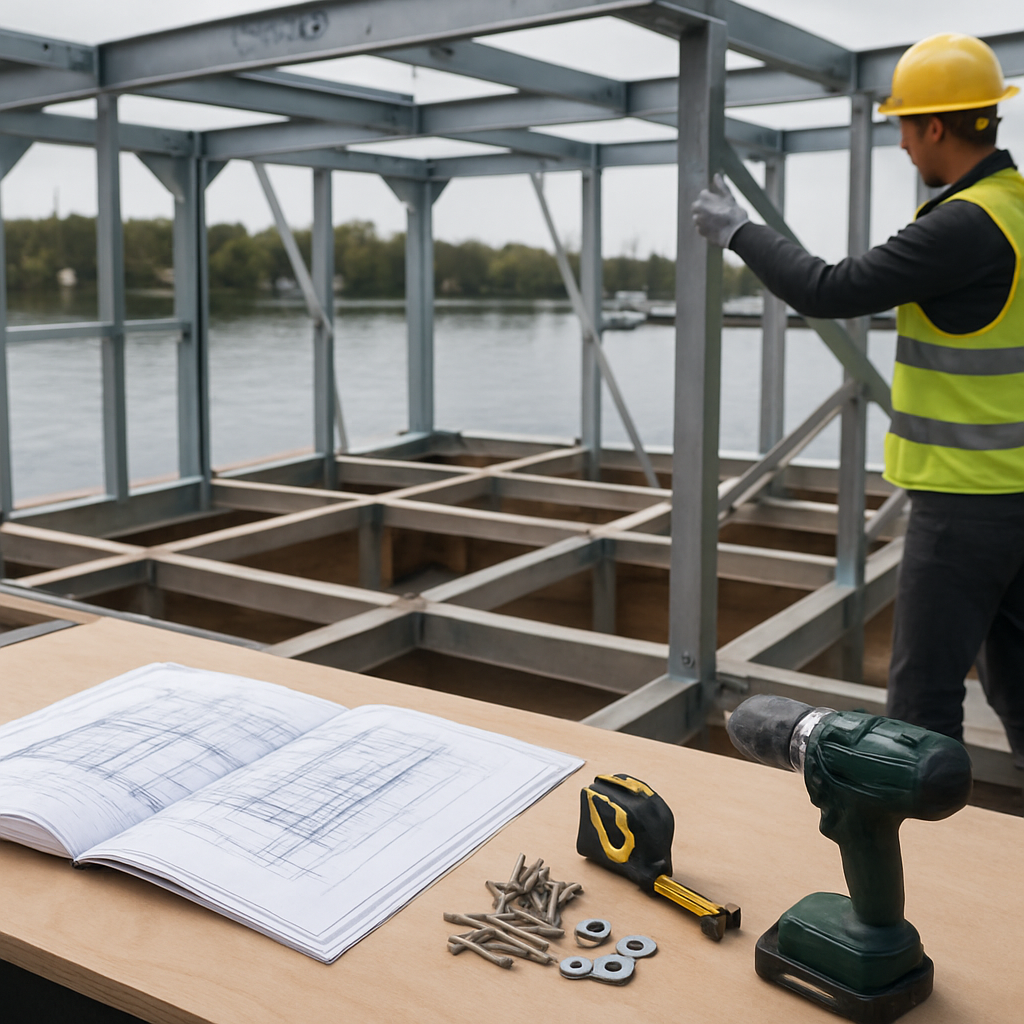
A level and square work platform is non-negotiable. Assemble a jig or levelling supports to hold floats or hull sections in alignment. If things sit crooked during assembly, the frame will carry that error into the final boat—no amount of sanding will fix it later.
3. Fabricate Primary Longitudinals
Cut stringers, center girders, and keel members. Pre-fit before you paint or prime. Drilling holes and countersinking before coating prevents damage to finishes. For metal, deburr holes and temporarily fit with bolts to check alignment.
4. Install Transverse Frames and Bulkheads
Transverses add torsional stiffness. Bulkheads—decide if they’re structural and watertight or non-structural partitions. Fasten bulkheads with through-bolts and bedding compound or with bonded joints in composite constructions.
5. Connect Primary to Secondary Members
Once primaries are true, add secondary stringers and deck beams. Use temporary bracing to hold geometry while you secure connections. When bolting, use backing plates to spread loads and dimple or countersink where necessary to avoid stress risers.
6. Fit Decking and Superstructure Supports
When fitting deck sheathing—plywood, composite panels, or aluminum—stagger joints and use adequate glue and fastener spacing. Glue-first-and-screw approach reduces squeaks and increases joint stiffness.
7. Apply Corrosion and Moisture Protection
For timber: epoxy-seal end grains, coat all faces and edges, and paint or varnish exposed areas. For steel: sandblast where possible, prime and topcoat with marine-grade paints. For aluminum: clean, prime with an appropriate etch primer, and use non-conductive fasteners where necessary.
8. Test, Inspect, and Adjust
Before you call it done, load test the main deck and floats. Simulate living loads and check for creaks, deflection, and fastener movement. Correct any soft spots or unexpected deflection with additional stiffeners or redesigned joins.
Tools and Equipment Essentials for Structural Frame Assembly on a Houseboat
Plain truth: having the right tools reduces mistakes and saves time. You don’t need every tool under the sun, but prioritize measuring and alignment tools, cutting tools fit to your materials, and safe handling gear.
Measuring and Layout
Tape measures, framing squares, laser levels, and long straightedges are your best friends. If you can’t measure twice, you’ll cut twice—and that usually ends badly.
Cutting and Joining
For wood: circular saws, jigsaws, routers and a good drill-driver. For metal: angle grinders, chop saws, or band saws; for welding tasks, MIG or TIG units are essential. Invest in good clamps—every carpenter will tell you clamps are life.
Safety and Handling
Hoists, straps, and stands help move heavy sections safely. Don’t cheap out on PPE—respirators for composites, weld helmets for metalwork, and gloves and eye protection for everything else. A small first-aid kit and a plan for lifting heavy members will keep you out of trouble.
Structural Frame Assembly: Common Pitfalls and How to Avoid Them
Even seasoned builders run into the same traps. Here are the big ones and how to avoid them.
Pitfall 1 — Skipping Alignment Checks
Why it happens: impatience, “close is good enough” mindset. Consequence: misaligned frames that cause uneven wear and poor handling. Fix: check alignment at every phase with a laser level and framing squares. It’s cheap and fast—do it.
Pitfall 2 — Poor Corrosion Control
Why it happens: not understanding galvanic action, or thinking coatings are optional. Consequence: rapid metal degradation or hidden rot. Fix: pick compatible metals, seal timber, and apply appropriate primers and topcoats. Add drainage and ventilation to reduce trapped moisture.
Pitfall 3 — Undersized Fasteners and Sparse Coverage
Why it happens: trying to save money or time. Consequence: joint failures and delamination. Fix: follow recommended fastener schedules, use backing plates on thin materials, and torque bolts properly.
Pitfall 4 — Bad Bonding Practices
Why it happens: skipping proper surface prep, wrong adhesive choice, or poor cure conditions. Consequence: adhesive failures and weakened composite or plywood assemblies. Fix: read and follow adhesive manufacturer instructions, prepare surfaces meticulously, and cure in recommended temperature/humidity.
Pitfall 5 — Designing Out Maintenance Access
Why it happens: aesthetics or underestimating future needs. Consequence: hard-to-reach areas that rot or corrode unnoticed. Fix: purge the “make it all seamless” urge—design removable panels and inspection hatches for critical areas like junctions, bilges, and through-bolts.
Structural Frame Assembly: Design Considerations for Longevity and Stability
This is where engineering meets practical living. Good structural design reduces surprises and keeps you safer. The points below will help you select the right scantlings and layout for a long-lived houseboat.
Load Paths and Scantlings
Size primary members based on bending, shear and compression—not guesswork. Over-size where you’re unsure; it’s cheaper to add a bit more material now than to retrofit reinforcements later. Consider service loads rather than idealized loads; liveaboard furniture and systems add up.
Center of Gravity and Stability
Stability isn’t glamorous but it’s crucial. Position heavy items low and close to the centerline. After assembly, check your vertical center of gravity versus metacentric height—if you’re unfamiliar with these terms, a naval architect or experienced surveyor can run a simple stability check for you.
Redundancy and Watertight Compartments
Redundancy means designing so one failure doesn’t ruin everything. Watertight bulkheads, independent bilge pumps and separated floatation areas are all simple ways to add redundancy. A single compromised compartment should not sink the whole houseboat.
Drainage, Ventilation, and Condensation Control
Moisture is a silent enemy. Provide slope to bilge areas, scuppers for drainage, and ventilation to prevent condensation. Use breathable insulation and vapor barriers where appropriate. Think like a house: airflow beats mold.
Thermal and Acoustic Comfort
Structural cavities are great places for insulation. Open-cell foam, closed-cell foam, or mineral wool each have pros and cons—consider moisture tolerance and fire safety. A quiet boat is a more livable boat; decouple noisy machinery from the frame when possible.
Practical Checklist Before Launch
- All primary joints inspected; bolts torqued and welds checked.
- Corrosion protection applied and verified; sacrificial anodes installed.
- Drainage and bilge systems tested for flow and auto-start.
- Weight distribution confirmed under simulated load.
- Access panels installed for key areas; documentation of locations kept.
- Flotation and stability tested in controlled conditions; minor adjustments made as needed.
Comprehensive FAQ — Structural Frame Assembly
Q: What materials should I choose for Structural Frame Assembly on my DIY houseboat?
A: It depends on size, budget, and how much maintenance you want. For smaller DIY projects, marine-grade plywood and solid timber are approachable, affordable and easy to work with. For larger builds, aluminum offers a great strength-to-weight ratio and corrosion resistance if detailed properly, while steel gives ultimate strength but demands rigorous corrosion protection. Composites are excellent for integrated shapes but need lamination skill. Think about long-term maintenance: if you don’t want to sand and recoat every few years, favor materials that resist corrosion and rot.
Q: Can I weld the frame myself, and when should I hire a pro?
A: If you’re certified and experienced in structural welding, you can weld; otherwise hire a professional. Welding aluminum is especially tricky due to heat control and porosity; steel requires qualified welders for critical seams. For DIYers, use bolted connections where possible and reserve welded joints for sections welded by a pro. This balances cost with safety and long-term reliability.
Q: How do I calculate loads and size beams for the frame?
A: Begin by itemizing dead loads (structure, decking), live loads (people, furniture), and concentrated loads (engine, tanks). Use conservative values—liveaboard loads can surprise you. For final scantlings, use marine design references or consult a naval architect. If you want a quick rule-of-thumb for small builds, size primary stringers to resist expected bending moments with a safety factor; but for anything beyond a simple weekend project, get professional verification.
Q: What’s the best way to prevent timber rot and corrosion at joints?
A: Prevent water ingress and ensure drainage. Seal timber end grains with epoxy, use marine-grade bedding compounds under through-bolts, and keep fasteners accessible for inspection. For metals, prime cut edges and use compatible alloys with insulating washers where metals meet. Proper ventilation and removable inspection panels are also key—if you can’t see a joint, you’re likely to miss early signs of failure.
Q: Which fasteners and adhesives are recommended for marine structural work?
A: Use 316 stainless steel fasteners for most marine exposure; for higher corrosion environments consider duplex stainless. For bonding plywood and laminates, marine epoxies are the go-to; Sikaflex-type sealants can be used for non-structural seams. For metal-to-metal joins, use approved structural adhesives only as specified and combine with mechanical fasteners for safety.
Q: How often should I inspect my houseboat’s structural frame?
A: Inspect at least once a year and after any grounding, collision, heavy storm or unusual loading event. Check all through-bolts, welds, and areas where water can collect. Inspect sacrificial anodes, paint/coating condition, and any flexible sealants—catching small problems early saves hours and money down the line.
Q: How do I test flotation and stability before launch?
A: Perform staged load tests on land if possible—place equivalent live loads on the deck and check deflections. For stability, calculate the center of gravity and metacentric height; if you don’t have the expertise, get a naval architect or surveyor to run a basic inclining test once afloat. Also do a controlled float test close to shore to observe trim, list and bilge behavior.
Q: What are typical costs for a structural frame?
A: Costs vary widely: a small plywood/timber frame for a DIY 20–30ft houseboat might run a few thousand dollars in materials, while aluminum or steel primary structures for larger builds can be tens of thousands. Labor (especially welding) and finishing treatments add up. Always budget contingency for coatings, fasteners, and rework.
Q: Which tools are essential and which should I rent or hire out?
A: Essential: good measuring tools (laser, squares), quality saws and drills, and safe lifting gear. Rent or hire heavy equipment and specialist services: plate rolling, large-section welding, CNC cutting, or sandblasting. If you need a welder for critical structural joints, it’s often better to hire a pro than risk poor-quality welds that compromise safety.
Q: How should I design access for maintenance and inspections?
A: Plan removable inspection panels at bulkheads, junctions and bilge areas. Leave crawl zones where practical and avoid permanently sealing off spaces that might trap moisture. Label access points in your build documentation so nothing gets forgotten during future repairs.
Q: What permits or regulations should I check before building?
A: Regulations depend on your location and intended use. Recreational houseboats often have fewer rules than commercial passenger vessels, but local maritime authorities, marina rules, and insurance companies may require inspections or certifications. Before you start, check with your local harbor authority and a marine surveyor to understand necessary permits and compliance requirements.
Q: How do I manage galvanic corrosion between dissimilar metals?
A: Prevent direct contact between dissimilar metals using insulating washers, sleeves or gaskets. Choose compatible alloys where possible and install sacrificial anodes to protect submerged metal. Maintain coatings and inspect electrical continuity—stray currents accelerate galvanic attack. Simple measures early on save you expensive replacements later.
Conclusion
Structural Frame Assembly is the foundation of a trustworthy houseboat. It’s where careful planning, smart material choices, correct detailing and disciplined construction meet to produce a home you can rely on. Take your time in the planning phase, be conservative with load assumptions, protect every vulnerable surface from moisture and corrosion, and make inspection easy. If you do these things, you’ll save time, money, and frustration—and you’ll get to savour more sunrises from a boat that feels rock-solid beneath your feet.
Ready to get hands-on? Start by reviewing your framing plan and marking the heavy items. If you want, jot down your questions and tackle them one at a time—this build is a marathon, not a sprint. And remember: a little extra care during Structural Frame Assembly goes a long way toward years of worry-free cruising.