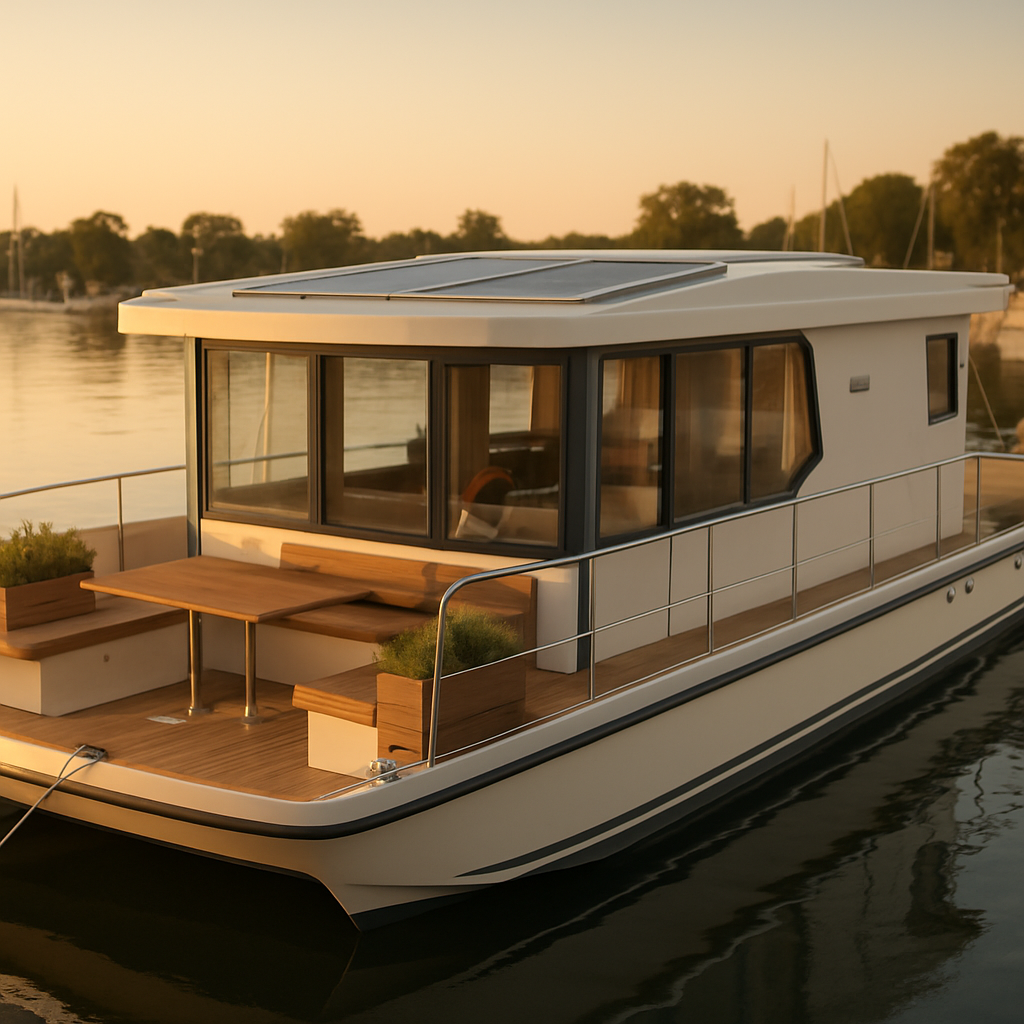
Want a Floating Home That Lasts? Discover Houseboat Construction Techniques That Turn Ideas into Reality
If Du have ever daydreamed about waking up to water lapping gently against your hull, or sipping coffee on a deck that Du built with your own hands, Du are in the right place. This guest post walks Du through practical, no-nonsense Houseboat Construction Techniques—from planning and materials to systems and space-saving interiors. Du’ll get actionable steps, realistic trade-offs, and tips that seasoned builders swear by. Ready? Let’s dive in.
If Du’re thinking about electrical runs and how they snake through tight compartments, take a look at practical routing examples that keep wiring safe, short, and accessible. For hands-on guidance on optimizing cable paths, breaker placements, and how to minimize voltage drop in confined marine spaces, check this detailed resource on Electrical System Routing. Proper routing saves headaches and keeps systems serviceable for years.
Curious where to find more in-depth tutorials, templates, and community feedback as Du plan your build? The central hub at homeboatbuilding.com collects plans, lessons learned, and project galleries from builders at different skill levels. Visiting the site early in your project will give Du checklists, downloadable material guides, and reader comments that can help Du avoid common pitfalls and refine your approach before Du invest time and money into construction.
Sealing the hull is where meticulous technique pays off. For a step-by-step approach to bedded fittings, seam preparation, and long-term maintenance tips, the piece on Hull Sealing Techniques provides clear examples of proper scarfs, fillets, and sealant choices for different hull materials. Learn how to spot early signs of sealant failure and which backing techniques prevent stress concentrations around through-bolts and high-load fittings.
Insulation choices can make or break comfort; if Du want methods that balance thermal performance with serviceability, consult the practical breakdown at Insulation Installation Methods. That guide walks Du through foam panel edge sealing, spray-foam pros and cons, and how to protect cores from moisture. Following these methods reduces condensation and helps your heating or cooling systems work less hard, saving energy and frustration.
Frame assembly sets the baseline for a straight, sturdy superstructure—so learning best practices matters. Detailed steps for joinery, spacing, and temporary bracing are in the Structural Frame Assembly guide, where Du’ll find tips on fairing frames, aligning stringers, and using templates to maintain symmetry. Proper assembly avoids later stress cracks and ensures skins lay smoothly without forced distortion.
Joints and transitions are the troublemakers of waterproofing; get them right by studying techniques for bedding, filleting, and flexible connections. The write-up on Waterproofing Joint Details explains how to select compatible sealants, prepare substrates, and use mechanical fastening with sealant fillets to extend service life. Paying attention to these details early reduces maintenance cycles and improves long-term integrity of the hull and deck interfaces.
Essential Houseboat Construction Techniques: A Practical Guide from HomeBoatBuilding.com
Start by asking the basics: What will Du use the houseboat for? Weekend escapes, full-time liveaboard, or long coastal trips? Your answer shapes almost every decision—from hull type and insulation to the electrical setup. These Houseboat Construction Techniques focus on priorities: safety, buoyancy, durability, and comfort.
Plan First, Build Second
A solid build starts with a clear plan. Sketch out the sequence: hull and flotation, framing, sealing, systems rough-in, interior fit-out, then commissioning. Build checklists for each stage and schedule inspections—don’t wing it. Du’ll thank yourself later when systems are accessible and nothing leaks.
Regulations, Safety, and Real-World Constraints
Before Du cut wood or weld aluminum, research local maritime regulations. Are there specific waste discharge rules? Registration requirements? Electrical codes? Safety isn’t optional. Lifejackets, fire extinguishers, and properly installed smoke and CO detectors save lives—no debate.
Buoyancy and Weight Management
Estimate gross weight early. Count hull, structure, water, fuel, gear, and people. Keep heavy items low and centered for trim. Small mistakes in weight distribution are surprisingly hard to fix once the interior is built. Consider mock-ups or temporary ballast to validate your layout before final fastenings.
Tools, Workspace, and Workflow
Set up a workshop with basic but reliable tools: circular saw, jigsaw, drill/driver, planer, orbital sander, and clamps. Add a laser level and strong sawhorses. For composite work, ventilate properly and use PPE. A tidy workspace reduces mistakes and improves morale—yes, it matters.
Material Selection Techniques for Durable Houseboats: Tips from HomeBoatBuilding.com
Picking the right materials affects lifespan, weight, cost, and maintenance. Your environment—freshwater lake vs. salt-spray coast—will nudge Du toward different choices. Below are material choices with practical pros and cons to help Du decide.
Marine Plywood vs. Composites vs. Metals
Marine plywood is work-friendly and affordable for cabins and non-skin panels, but edges must be sealed and exposure avoided. Fiberglass (FRP) is excellent for sealed hulls and repairs—once Du learn resin handling. Aluminum offers corrosion resistance and lightness but needs TIG welding skills and thoughtful joining to dissimilar metals.
Composite Panels and Core Choices
Foam- or balsa-cored panels give you great stiffness-to-weight ratios, ideal for superstructures and decks. However, cores must be perfectly sealed. Any water ingress leads to soft spots and expensive repairs. Use sealants, edge tapes, and careful through-bolting strategies.
Fasteners, Adhesives and Coatings
Use 316 stainless or silicon bronze fasteners for corrosion resistance. For bonding, select marine-grade epoxy when strength and adhesion are critical. Topsides need UV-stable paint; deck surfaces should have slip-resistant coatings. Don’t skimp on sealants for through-hulls and bedding compounds—cheap in, expensive out.
Balancing Weight and Durability
Every ounce counts, especially on displacement hulls. Go lightweight for the superstructure and robust at the waterline and hull bottom. Reinforce high-wear zones and use sacrificial elements where appropriate (e.g., replaceable rub rails).
Framing, Hull Construction, and Sealing Techniques for Seaworthy Houseboats
The hull and framing form the backbone of a seaworthy houseboat. Focus on structural continuity, watertight joints, and redundancy for safety.
Choosing a Hull Type
- Pontoon (multi-hull) — stable, shallow draft, easier DIY construction, ideal for calm waters and lakes.
- Displacement monohull — more efficient for long-distance travel and rough water; heavier and more complex to build.
- Catamaran — combines stability with improved efficiency; structural bridging and crossbeams are critical.
Framing Methods
Frame layouts should support deck loads, cabinetry, and living spaces while resisting torsion. Two common approaches:
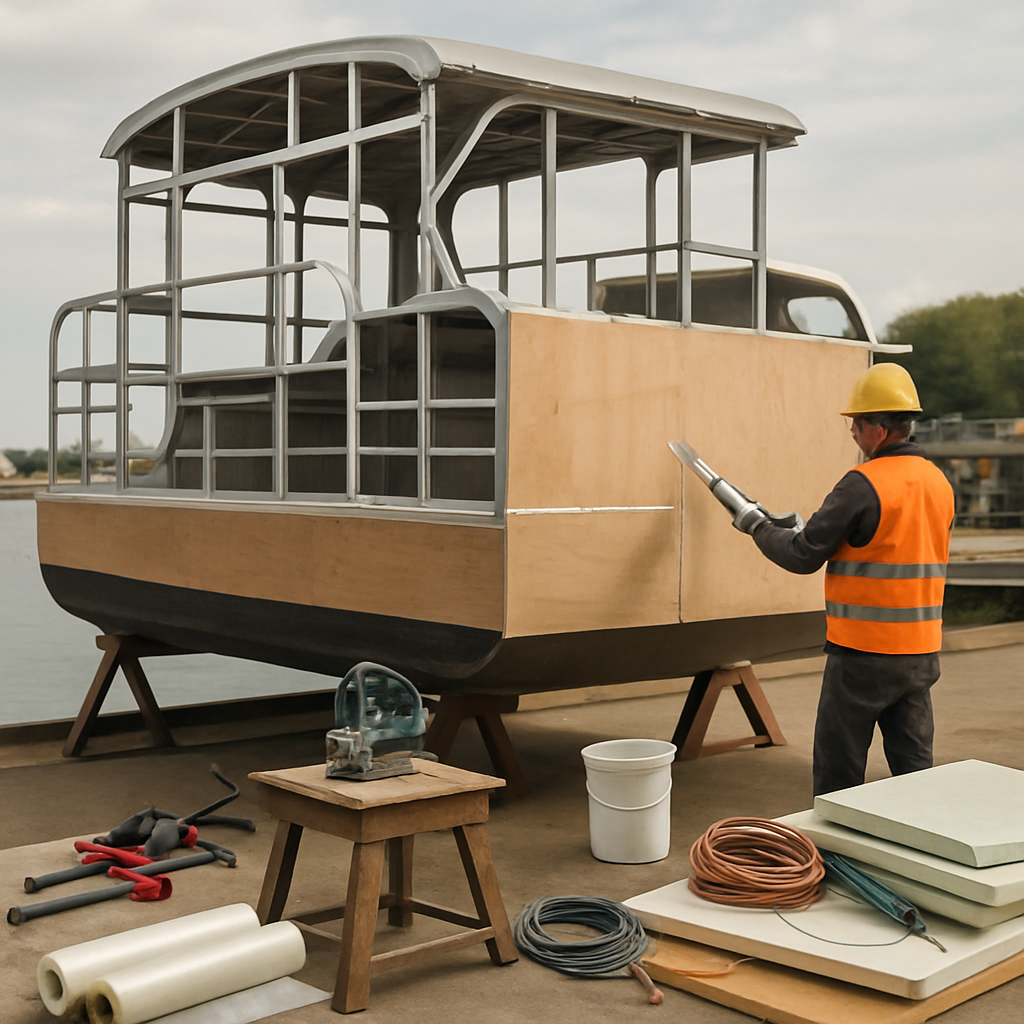
- Traditional rib-and-stringer framing: ribs spaced to manufacturer’s specs, longitudinal stringers to distribute loads. Good for plywood/FRP hulls.
- Box-frame/aluminum framing: welded or bolted extrusions forming modular compartments, ideal for aluminum or composite constructions.
Hull Skinning and Composite Lamination Steps
- Fair the frame to the designed shape with battens and filler where needed.
- Apply peel ply and release films as required for multi-layer laminates.
- Wet out fiberglass cloth with resin, lay in successive layers, and consolidate with rollers to remove air and achieve proper fiber-to-resin ratio.
- Cure fully under recommended conditions; sand and fair between layers for a smooth finish before final coatings.
Sealing Techniques and Watertight Integrity
Sealing is both a preventive and repair strategy:
- Seal all penetrations—through-hull fittings, fasteners, and bolts—with marine-grade polysulfide, polyurethane sealant, or epoxy fillets depending on the material and load.
- Use flange backing plates for high-load fittings to distribute forces and prevent localized crushing or leakage.
- Design compartmentation: multiple watertight compartments (bulkheads) limit flooding and improve safety.
- Regularly inspect and reseal bedding compounds and joints—sealants age with UV and thermal cycles.
Waterproofing, Insulation, and Comfort Techniques for All-Year Use
To make a houseboat habitable year-round, control moisture, temperature, and condensation by selecting the right insulation, ventilation, and waterproofing strategy.
Waterproofing Strategies
- Hull coatings: antifouling bottom paints for saltwater, topside marine paints with UV blockers, and epoxy barrier coats for wood.
- Deck and roof membranes: use durable, UV-stable membranes or elastomeric coatings for continuous protection at seams and high-traffic zones.
- Interior moisture barriers: vapor barriers behind interior paneling where cold bridging might cause condensation.
Insulation Options and Placement
Choose insulation with the right R-value for your climate and account for space constraints:
- Closed-cell spray foam: excellent thermal insulation and acts as an extra moisture barrier; adds structural stiffness but increases permanence and complexity for future repairs.
- Cored panels (foam or balsa): lightweight and thermally efficient—ensure edges and penetrations are sealed to avoid core saturation.
- Fiberglass or mineral wool batts: economical and good for non-structural cavities; requires vapor control to prevent trapping moisture.
Ventilation, Heating, and Dehumidification
Controlling humidity is crucial:
- Install mechanical ventilation: balanced intake/exhaust fans, especially for kitchens and bathrooms.
- Use heat pumps or small diesel heaters for efficient heating in cold climates; ensure combustion appliances are vented and safe for marine environments.
- Consider a dehumidifier for damp climates and during offseason storage to minimize mold and corrosion.
Space-Saving Interior Layout Techniques for Petite Houseboats
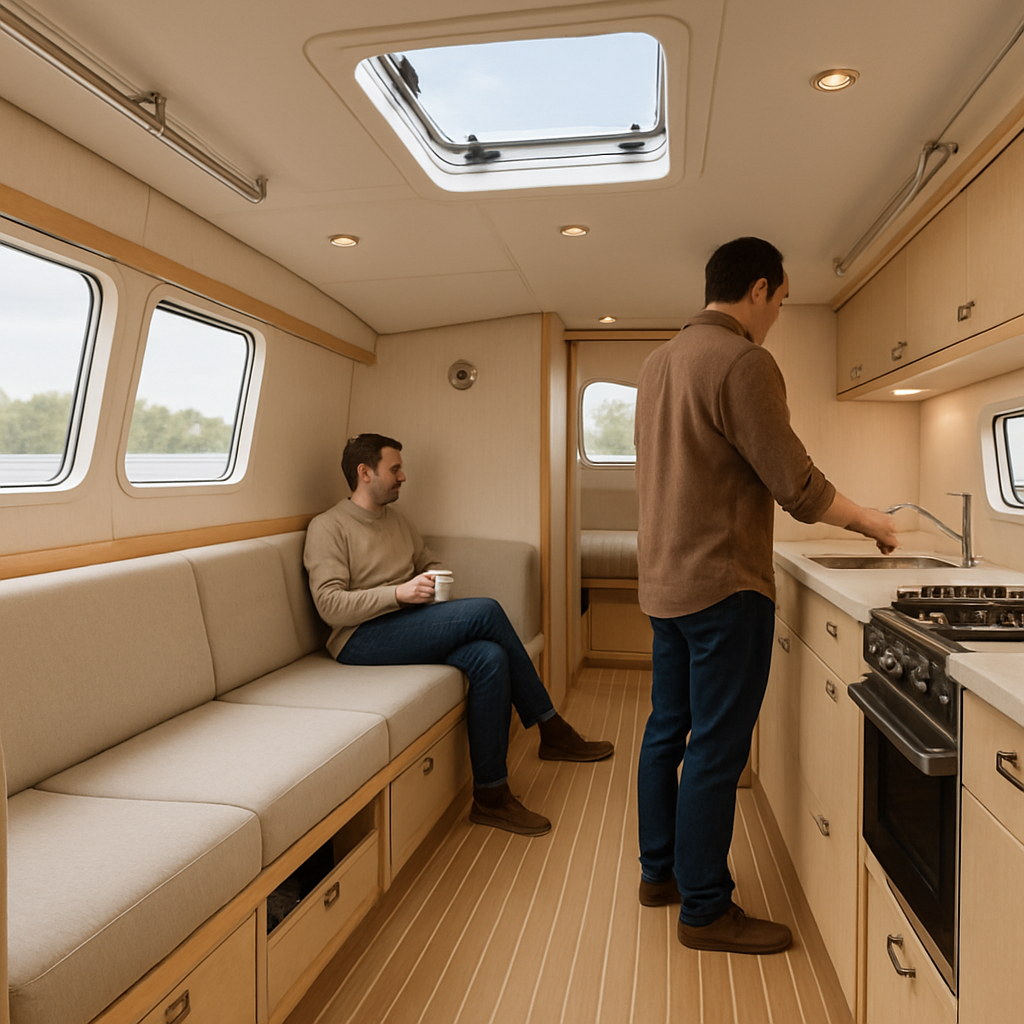
On small houseboats every inch counts. Design for multifunctionality, easy access to systems, and optimized storage.
Design Principles for Small Spaces
- Open-plan common area: reduce fixed partitions to increase perceived space and flexibility.
- Vertical storage: use wall-mounted cabinets, overhead lockers, and under-seat storage.
- Multifunctional furniture: convertible sofas, fold-down tables, Murphy beds, and sliding partitions.
- Light and color: maximize natural light and use light finishes to make areas feel larger.
Smart Layout Examples (Practical Tips)
Examples of efficient arrangements:
- Galley along one wall with a flip-up counter extension—saves space while preserving work area.
- Wet bath with shower over the toilet and foldable seats—compact but functional.
- Raised platforms for sleeping with storage underneath—keeps heavy items low and central.
- Sliding or pocket doors to eliminate swing clearance for doors in narrow cabins.
Access for Maintenance
Always design with removable panels and access hatches for plumbing, wiring, and mechanical components. Concealed systems are fine, but accessibility reduces repair time and prevents costly demolition later.
Electrical, Plumbing, and Systems Integration Techniques on Houseboats
Systems integration requires attention to marine-grade components, safety practices, and redundancy. Plan systems early so routing and space allocation are incorporated into structural design.
Electrical Systems: Best Practices
- Dual power options: shore power for docked charging and inverters/chargers tied to battery banks for off-grid use. Consider solar panels with MPPT controllers for renewable charging.
- Wire selection and routing: use marine-grade tinned copper wiring and properly sized cables for expected loads. Keep DC circuits short and simple; fuse/breaker near source for protection.
- AC systems: use GFCI-protected outlets in wet areas; separate AC and DC distribution panels; use isolation transformers or galvanic isolators for corrosion protection in saltwater marinas.
- Bonding and grounding: follow marine electrical standards to ensure safety and reduce stray current corrosion.
Plumbing Systems and Waste Management
- Fresh water: pressurized systems with accumulator tanks reduce pump cycling. Use potable-grade hoses and fittings, and plan for easy winterization if freezing is expected.
- Greywater and blackwater: understand local disposal regulations; many areas require holding tanks with pump-out facilities. Consider composting toilets to reduce blackwater complexity.
- Bilge and drainage: sumps with automatic bilge pumps and alarms. Design bilge access for inspection and ensure float switches are reliable and serviceable.
- Materials: use corrosion- and UV-resistant fittings; avoid cheap plastics where heat or chemicals are present.
HVAC, Fuel, and Safety Systems
Key points for integration:
- HVAC: compact heat pumps provide heating and cooling with lower fuel dependence than combustion heaters, but consider backup diesel/gas heaters in cold climates.
- Fuel storage: secure tanks low and in ventilated compartments with fuel shutoffs. Observe separation from living spaces and electrical equipment.
- Fire safety: install smoke and CO detectors, fire extinguishers, and an automatic fire suppression system in engine spaces if feasible.
- Monitoring: digital battery monitors, tank level sensors, and integrated control panels improve situational awareness and reduce surprises.
Systems Testing and Commissioning
- Pressure-test plumbing at 1.5x working pressure and run continuous leak checks during initial weeks of use.
- Load-test electrical systems under realistic loads to verify wiring, inverter behavior, and thermal performance.
- Sea trials: perform incremental tests—maneuvering, station-keeping, and emergency procedures—before committing to extended voyages.
Common Mistakes and How to Avoid Them
Learn from others’ errors to save time and money:
- Underestimating weight: always build a weight budget and verify as you go. Surprises can ruin performance and safety.
- Poorly sealed penetrations: any missed through-hull or cable entry can lead to progressive leaks and structural damage.
- Ignoring service access: inaccessible systems lead to costly retrofits and frustrated repairs.
- Overcomplicated systems: for many liveaboard projects, simplicity equals reliability—use robust, proven components over novelty.
Final Checklist Before Launch
- Hull and deck seams sealed and cured; visual and pressure-checked where applicable.
- All penetrations bedded and backed; through-hull fittings verified and clamped.
- Electrical systems fused, labeled, and GFCI-protected; battery ventilation and secure fastenings in place.
- Plumbing lines pressure-tested; anti-siphon and venting in place for toilets and tanks.
- Safety equipment installed and accessible: lifejackets, fire extinguishers, bilge alarms.
- Weight and balance review complete; sea trial schedule and emergency plan prepared.
Building a houseboat is a substantial but rewarding undertaking. Focus on sound materials, watertight construction, accessible systems, and ergonomic interiors to create a floating home that performs well and lasts. Use this guide as a roadmap—combine it with detailed plans, local regulations, and, where needed, professional inspections—to turn the dream of a houseboat into a safe, comfortable reality.
FAQ — Common Questions About Houseboat Construction Techniques
1. How much does it usually cost to build a houseboat?
Costs vary widely depending on size, materials, and whether Du do the work yourself. Small DIY pontoon houseboats can start around $20,000–$40,000 if Du source used pontoons and keep finishes simple. A well-appointed liveaboard built from scratch with quality systems can easily reach $100,000–$300,000. Labor is the biggest variable—if Du hire professionals, budget significantly more. Tip: create a detailed bill of materials and add a 15–25% contingency for surprises, especially related to systems and marine-grade components.
2. Which hull type is best for my needs?
It depends on where Du plan to use the boat. Pontoons are great for calm inland waters, easy to build, and stable for entertaining, but they’re inefficient in rough seas. Monohulls suit coastal cruising and longer distances because they handle waves better and are more seaworthy. Catamarans give a mix of stability and efficiency but need careful structural bridging and complexity in construction. Choose based on water types, how much travel Du want to do, and your comfort with building complexity.
3. What materials give the best longevity with reasonable maintenance?
Aluminum and fiberglass hulls tend to offer long lifespans with proper maintenance. Aluminum is lightweight and corrosion-resistant if detailed correctly, but needs skilled welding and careful joint design. Fiberglass (FRP) is forgiving for DIY laminations and repairs, while marine-grade plywood remains a cost-effective choice for interiors and non-skin structures when epoxy-sealed. Use 316 stainless or silicon bronze fasteners and marine adhesives to minimize corrosion-related failures.
4. How long does a typical build take?
Timeline depends on scope and crew. A straightforward DIY conversion or small pontoon project might take 3–9 months of part-time work. A larger, fully-custom houseboat with complex systems and high-end finishes could take 12–24 months or longer. Delays often come from waiting on specialized parts, curing times for composites, regulatory approvals, and system troubleshooting—plan a realistic timeline and expect some setbacks.
5. What permits and inspections might Du need?
Permitting varies by country, state, and marina. Common requirements include vessel registration, inspections for safety equipment, and environmental rules for waste discharge. Some local authorities require structural or electrical inspections for liveaboard vessels used as residences. Early engagement with local harbor masters and marine authorities prevents costly rework. Keep records of inspections and certificates—they’re important for insurance and resale value.
6. How should Du insulate a houseboat to avoid condensation?
Condensation control combines good insulation with ventilation. Closed-cell spray foam provides both high R-value and vapor resistance, but it complicates future access. Cored panels and well-sealed foam boards are lighter and effective if edges are sealed. Pair insulation with a vapor barrier in cold climates and mechanical ventilation (balanced intake/exhaust) to manage moisture. Dehumidifiers help in humid areas, and thermal breaks at cold bridges reduce condensation risks.
7. What’s the best way to manage plumbing and waste?
Follow local laws first—many harbors require holding tanks with pump-out for blackwater. Greywater rules vary. Pressurized freshwater systems with an accumulator tank reduce pump noise and extend pump life. For blackwater, composting toilets are an option that reduces tank complexity but add venting needs. Always install reliable bilge pumps with alarms and design accessible service points for pumps, hoses, and valves to simplify maintenance and emergency access.
8. How can Du make the electrical system safe and reliable?
Use marine-grade components and proper routing: tinned copper wiring, correct wire sizing, and fuses at the source. Provide shore power with a properly sized shore-cord and an inverter/charger for off-grid periods. Protect wet areas with GFCI outlets and consider galvanic isolators in saltwater marinas to prevent electrochemical corrosion. Keep DC runs short, label circuits clearly, and add battery monitors so Du always know the state of charge.
9. What maintenance should Du prioritize after launch?
Prioritize regular hull and seal inspections, especially around through-hulls, bedding compounds, and fasteners. Antifouling maintenance for bottoms in saltwater is crucial. Check sacrificial anodes, test bilge pumps and alarms monthly, and inspect hoses, clamps, and electrical connections for corrosion. Keep a log of maintenance tasks and address small leaks or loose fittings quickly—minor issues can escalate if ignored.
10. Can Du realistically build a houseboat yourself, or should Du hire pros?
Many builders tackle parts of the project themselves—interiors, cabinetry, finishes—while hiring professionals for specialized tasks like welding aluminum hulls, engine installations, or complex electrical systems. Du can save a lot by DIY-ing what fits your skill set, but know your limits. Structural integrity, fuel systems, and certified electrical work often require professional input to meet safety standards and insurance requirements. A hybrid approach—DIY where practical and pro help where required—works well for most builders.
Wrapping Up: Next Steps
If Du feel inspired but a bit overwhelmed, start with a small project or retrofit to gain confidence. Join local builder groups, consult the detailed resources on homeboatbuilding.com, and consider a professional plan review before committing to big structural or systems decisions. With solid planning, attention to sealing and access, and sensible choices in materials and systems, Du can create a houseboat that’s safe, comfortable, and built to last.