Capture, Interest, Desire, Action: Master Electrical System Routing for a Safer, Smarter Houseboat
Imagine stepping aboard your finished houseboat: lights flick on instantly, the fridge hums quietly, navigation electronics respond, and the whole system runs without a hitch. That calm reliability starts with thoughtful Electrical System Routing. In this guide you’ll get practical steps, real-world tips, and checklist-ready actions so you can plan, install, and maintain a routing layout that keeps your boat safe and serviceable for years. Ready? Let’s get into it.
Before we dive into the nuts and bolts of routing, keep in mind that your choices for structure and interior layout directly affect wiring paths. Early decisions about cabinetry, bulkheads, and equipment placement can make the difference between neat, short runs and a spaghetti mess you’ll curse at during the next retrofit. It’s worth pausing now and thinking about the physical routing corridors you’ll reserve behind panels and under benches.
When planning routing corridors, it’s also smart to reference related construction topics that influence how and where you can run cables: brush up on Houseboat Construction Techniques to understand framing and stringer layouts that accommodate conduit, review best practices for thermal performance by reading Insulation Installation Methods, and consider sealing and bonding methods from Waterproofing Joint Details to ensure cable penetrations stay dry. These linked overviews will help you harmonize electrical routing with the rest of your build and avoid later conflicts.
Electrical System Routing for Houseboats: Best Practices by HomeBoatBuilding.com
Electrical System Routing isn’t glamorous, but it makes or breaks a build. Poor routing leads to noise, corrosion, shorts, and headaches; good routing disappears into the background and makes maintenance straightforward. Below are foundational best practices to adopt from day one:
Start with access open
Run your wiring before you close bulkheads, lay the flooring, or install cabinetry. It’s far simpler to run a conduit across an open stringer than to chase wire through finished trim. Think like a tech: every run should have an obvious, accessible path and spare capacity for future devices.
Separate systems and respect spacing
Keep AC and DC runs apart. Low-voltage control wires should be separate from high-current feed lines. If crossing is unavoidable, do so at 90-degree angles to reduce electromagnetic interference. Use metallic conduit or shielded cable where noise is a concern.
Protect, clamp, and label
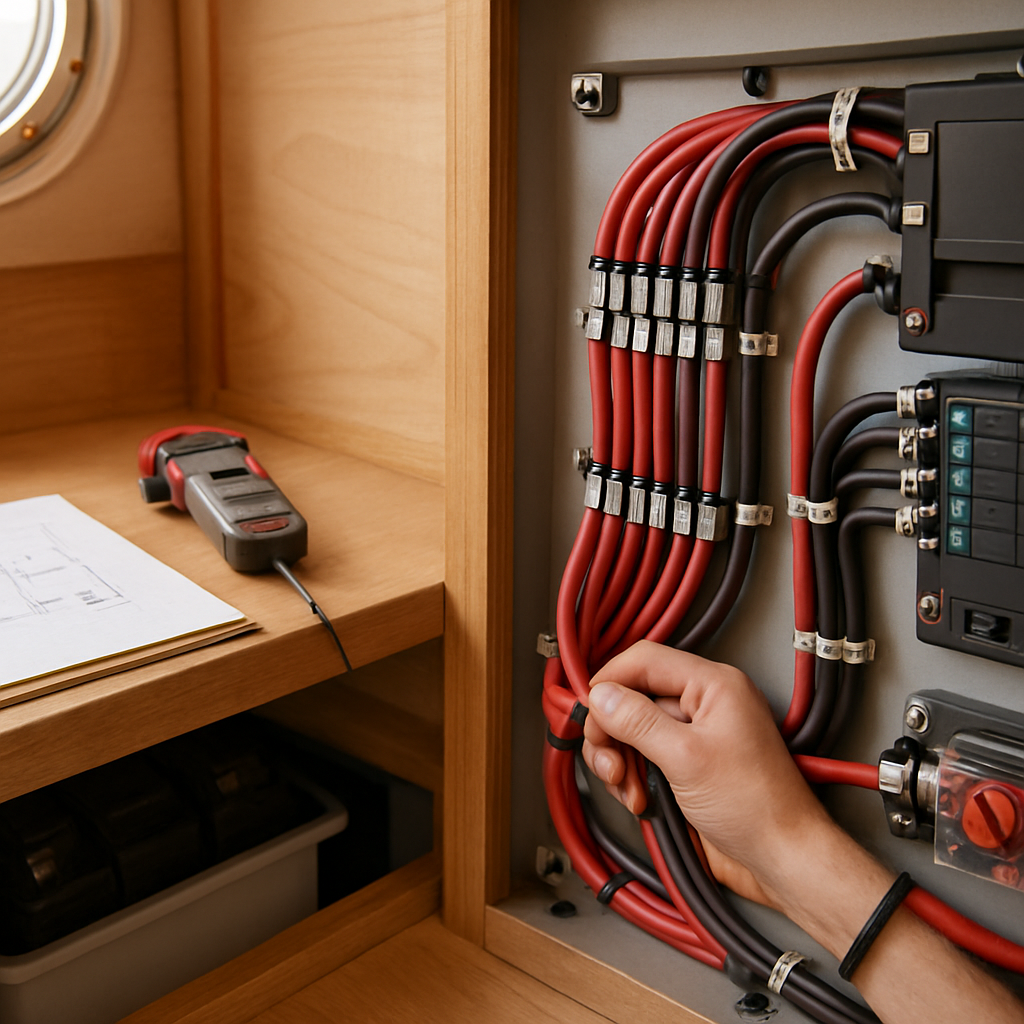
Secure wiring with clamps — stainless where exposed, nylon where you need to avoid galvanic contact. Use grommets when passing through holes, leave service loops near panels and devices, and label both ends of every wire clearly with durable, marine-rated tags.
Design for maintainability
Put junctions in accessible, waterproof boxes, leave spare conduit paths, and centralize distribution components. If you or a future owner need to change or add circuits, quick access pays off in saved time and money.
Planning Your Electrical Layout: From Design to Routing for HomeBoatBuilding.com Readers
Good planning beats frantic re-wiring later. Use these steps to move from idea to fully routed wiring scheme.
Create a complete inventory
List every electrical load: navigation lights, galley appliances, HVAC, water pumps, chargers, outlets, and electronics. For each device, note voltage (12V/24V or AC), continuous current draw, and surge or peak current. Don’t forget unknown future loads — it’s smart to plan for extras like a future inverter or battery monitor.
Draw a single-line diagram
A single-line diagram is your map. Sketch the shore inlet, main AC breaker, AC panel, inverter/charger, battery bank, DC distribution, and major loads. Then overlay proposed cable routes on your hull and deck plans — this helps spot potential conflicts with plumbing, fuel lines, or structural members.
Calculate voltage drop and size conductors
For DC systems, voltage drop matters. Aim for no more than 3% on critical circuits and keep under 5% for secondary loads. Use the formula Vdrop = I × R × L and refer to conductor resistance charts, but when in doubt, upsize the conductor — it’s cheaper than suffering poor performance.
Place panels smartly
Locate DC distribution near the battery bank and the inverter to keep high-current runs short. Put AC distribution where shore power and generator lines can feed it with minimal run length. Centralization reduces cable clutter and simplifies fault finding.
Plan routes, not just endpoints
Mark the route for every major run. Think vertically and horizontally: through stringers, behind cabinetry, under benches. Identify where holes must be drilled and where sleeving or grommets are necessary. Always avoid routing heavy DC runs near fuel tanks or sharp edges.
Choosing Conduits, Cables, and Fastening Methods for Safe System Routing on a HomeBoatBuilding.com Project
Material choice determines long-term reliability. Marine environments are brutal: salt, moisture, vibration, and UV all conspire to weaken ordinary components. Choose gear built or rated for marine use.
Conduit choices — what to use where
- PVC (Schedule 40) conduit: Cheap and non-conductive. Good for protected interior runs. Protect from UV when exposed topside.
- Liquid‑tight flexible metal conduit (LFMC): Great where you need flexibility and shielding, like near engines or moving components.
- Corrugated plastic flex (split loom): Handy for bundling and protecting low-force cable runs; not sufficient where mechanical damage is likely.
- Stainless or galvanized metal conduit: Use sparingly and only with corrosion protection; it’s strong but needs care in saltwater environments.
Cable selection
Prefer tinned copper stranded conductors. Tinning resists corrosion; stranded wires flex with vibration and are less likely to fatigue. For AC, use marine-rated shore cables and avoid household NM (Romex) unless it’s enclosed and meets code.
Choosing wire gauges
Match wire gauge to expected continuous current and length. Typical guidance: 14 AWG for small lights, 12 AWG for general circuits up to 20A, 10 AWG for 30A circuits or chargers, 6–4 AWG for main battery/inverter feeds. Always check voltage drop charts for long runs.
| Wire (AWG) | Typical Continuous Ampacity | Common Uses |
|---|---|---|
| 14 | 10–15 A | Small lighting, sensor lines |
| 12 | 20 A | Lighting, small outlets |
| 10 | 30 A | Medium chargers, inverters (short) |
| 6–4 | 60–95 A | Battery & inverter feeders |
| 2 and larger | 130 A+ | High current battery banks |
Fastening and abrasion protection
- Clamp every run — every 18–24 inches vertical, every 3–4 feet horizontal.
- Use rubber sleeves or grommets when passing through bulkheads or metal frames.
- Install strain reliefs at panels, inlets, and devices to prevent stress at terminations.
- Group small cables and protect them with split loom or conduit; tie wraps are fine but don’t cinch them too tight.
Battery Management and Shore Power Routing on Small Houseboats with HomeBoatBuilding.com Guidance
Batteries and shore power routing require both mechanical and electrical care. A bad battery layout is dangerous; a bad shore power layout invites corrosion and electrical faults.
Battery placement and ventilation
Locate batteries in a dedicated compartment above the bilge where possible. Flooded batteries demand venting to prevent hydrogen buildup; sealed lithium and AGM reduce that need but still benefit from an under-battery tray, ventilation, and temperature control. Make compartments accessible for inspection and replacement.
Battery cabling best practices
- Keep positive and negative runs as short and direct as possible to reduce voltage drop and heat.
- Fuse at the source: install ANL or bolt-on fuses near the positive terminal to protect wiring and prevent runaway faults.
- Use marine-grade terminals, adhesive-lined heat-shrink, and boot covers to reduce corrosion and accidental shorts.
- Install a robust main battery disconnect switch within reach of the helm or a safe emergency location.
Shore power routing essentials
Place the shore inlet to minimize cable length to the AC panel and avoid crossing walkways. Route shore power runs in dedicated conduits or channels, separate from DC runs. Provide strain relief at the inlet and at the distribution panel.
Shore power protection and isolation
- Install an appropriately rated inlet (30A or 50A) with a labeled shore breaker.
- Include a galvanic isolator or isolation transformer to mitigate galvanic corrosion when connected to shore power.
- Implement an automatic or manual transfer switch to avoid paralleling shore and generator power.
- Install a shore power monitoring device to alert you of unsafe polarity or high leakage currents.
Waterproofing and Cable Seals for Marine Electronics Routing: Tips from HomeBoatBuilding.com Tutorials
Moisture kills electronics faster than anything else. Waterproofing isn’t optional; it’s a core part of routing strategy.
Cable glands and entry seals
Use IP‑rated glands (IP67/IP68) for any exterior entries. Choose materials that won’t pit in saltwater — stainless or bronze housings with silicone or EPDM seals are common. Torque them correctly: under‑torqued means leaks, over‑torqued crushes the seal.
Sealed connectors and heat-shrink
- Prefer Deutsch or other IP68-rated connectors for exposed runs.
- Use adhesive-lined heat shrink over crimped terminals to form a durable moisture barrier.
- Consider silicone potting only for permanent, non-serviceable joints — otherwise, use sealed junction boxes for maintainability.
Enclosures and junction boxes
Mount junction boxes above expected water levels, label them, and leave spare capacity for future taps. Use gasketed, marine‑rated boxes for any installation that might see spray or splash.
Anti-corrosion measures
Coat exposed terminals with dielectric grease or corrosion inhibiting paste and inspect annually. Replace heavily corroded terminals instead of trying to patch them; fresh, clean connections are safer and more reliable.
Compliance, Codes, and Maintenance of Electrical System Routing: A HomeBoatBuilding.com Guide
Following standards keeps you safe and insurable. Codes also help you think through edge cases you might otherwise miss. Below are the key compliance and maintenance items to stay on top of.
Standards and regulations
- Use ABYC standards for U.S. projects and local equivalents elsewhere. ABYC covers wiring, battery installations, shore power, and bonding.
- Consult NEC requirements for shore power and AC distribution when applicable.
- Check marina rules and local codes concerning shore power hookups and bonding/grounding.
Labeling and color coding
Consistent color coding avoids mistakes: DC positive often red, DC negative black (or brown/black depending on region), and green/green-yellow for earth/ground. Label both ends of wires and panels clearly with circuit names, breaker sizes, and wire gauges.
Inspection schedule and maintenance
- Quarterly: Visual inspection of terminations, clamps, and shore inlet. Test polarity and basic functionality.
- Annually: Tighten terminals to specified torque, test batteries (hydrometer for flooded), and exercise disconnects and transfer switches.
- Every 3–5 years: Thermal imaging or load testing of main feeders to detect hot spots and high-resistance joints.
Common pitfalls to avoid
Don’t under‑size main DC feeds, skip fuses close to the battery, or ignore shore power isolation. These mistakes lead to fires, corrosion, and costly repairs. When in doubt, consult a certified marine electrician — it’s worth the cost.
Troubleshooting Checklist and Tools
When something goes wrong, the right tools and a methodical approach save time. Keep a small kit on board and use this step-by-step checklist.
Essential tools
- Multimeter and clamp ammeter
- Torque wrench and proper crimping tools
- Heat gun for shrink tubing
- Insulation resistance tester (megger) for longer runs
- Spare fuses, lugs, and pre-labeled spare wires
Troubleshooting steps
- Check fuses and breakers first — they’re cheap to test and often the cause.
- Measure battery voltage at rest and under load. Low voltage points to charging or battery issues.
- Check voltage drop across suspected feeds while under load; measure at both ends of the run.
- Look for hot connectors or discoloration; high resistance joints heat up under load.
- Isolate circuits sequentially to narrow down faults, and use the megger for insulation breakdown on questionable runs.
FAQs — Common Questions About Electrical System Routing
What exactly is Electrical System Routing and why should I care?
You can think of Electrical System Routing as the plan and practice of where, how, and with what materials you run every wire and cable on your houseboat. It matters because proper routing reduces the risk of shorts, fires, interference, and corrosion, and makes maintenance and upgrades far less painful. Poor routing creates long-term headaches — so getting it right up front saves time, money, and stress down the road.
How should I plan cable routes for my houseboat?
Start with a full list of loads and a single-line diagram showing panels, batteries, chargers, inverter, and shore inlet. Overlay proposed cable runs on the hull and layout plans, and mark holes, sleeving, and grommet locations. Favor straight paths, gentle bends, and keep high-current runs short. Reserve conduit space behind cabinets and under benches so you can pull new cables later without ripping things apart.
Do I need to separate AC and DC wiring?
Yes — separate AC and DC wiring whenever possible. Keep low-voltage control wires away from high-current DC feeders to prevent electrical noise and interference. If they must cross, do so at right angles. For sensitive runs, use metallic conduit or shielded cable to reduce EMI and make troubleshooting simpler.
How do I size conductors and calculate voltage drop?
Choose wire gauge based on expected continuous current and one-way run length. For DC circuits, aim for no more than a 3% voltage drop on critical loads and under 5% for less critical ones. Use Vdrop = I × R × L (I=current, R=resistance per length, L=one-way length) and consult resistance charts — or use an online calculator. When in doubt, go up one size; it’s a cheap insurance policy against poor performance.
Where should batteries be located and how should they be vented?
Place batteries in a dedicated, accessible compartment above the bilge. Flooded lead-acid batteries must be vented to prevent hydrogen buildup; AGM and lithium reduce vent needs but still benefit from ventilation and temperature control. Use trays to catch leaks, secure batteries against movement, and protect terminals with boots and heat-shrink to avoid accidental shorts.
What protections do I need at the battery and shore inlet?
Install a main fuse or ANL/bolt-on fuse as close to the battery positive as possible, and a clearly accessible battery disconnect. For shore power, use an inlet rated for the intended current (30A or 50A), a labeled shore breaker, and consider a shore power monitor. Also include galvanic isolation or an isolation transformer to protect against electrochemical corrosion when connected to marina power.
How do I waterproof cable entries and connectors?
Use IP‑rated cable glands (IP67/IP68) for external penetrations, torque them correctly, and choose corrosion-resistant materials. For exposed connectors, prefer IP68-rated plugs like Deutsch, and cover crimped joints with adhesive-lined heat-shrink. Mount junction boxes above expected water levels and use gasketed, marine-rated enclosures to keep moisture out while preserving serviceability.
Which standards and codes should I follow?
Follow ABYC standards for U.S. projects and check local equivalents elsewhere. For shore power and AC distribution, NEC rules may apply. Also consult marina requirements for bonding and shore hookups. Adhering to these standards reduces safety risks and helps with insurance and resale.
Can I route the electrical system myself or should I hire a professional?
If you’re comfortable with basic wiring, testing, and the relevant marine standards, you can do a lot of the routing and installation yourself. However, for shore power bonding, major inverter installations, and any time you’re unsure about safety-critical choices, hire a certified marine electrician. Paying for a professional inspection at key stages is a smart investment and can prevent dangerous mistakes.
What maintenance should I do to keep the routing reliable?
Inspect wiring quarterly for chafe, loose clamps, and corrosion. Annually, torque terminals to spec, load-test batteries, and test disconnects and transfer switches. Every 3–5 years consider thermographic scans on main feeders to find hot spots. Keep a simple tool kit and a record of your wiring diagrams and labels so troubleshooting is fast when something crops up.
Final Checklist Before Commissioning
- All runs labeled, clamped, and routed with strain reliefs and grommets where needed.
- Battery compartment secured and ventilated, with main fuse/disconnect installed close to battery terminals.
- Shore inlet and AC distribution wired, polarity tested, and galvanic protection installed.
- Documentation stored aboard: single-line diagram, wiring list, and photos of critical junctions.
- Basic toolkit and spare parts packed for the first cruise.
Electrical System Routing is more than a wiring job; it’s the backbone of a comfortable, safe liveaboard. Make routing decisions deliberately: plan for serviceability, use marine-grade materials, protect against water and corrosion, and respect code requirements. If something feels out of scope, hire a qualified marine electrician for the tricky bits — shore power bonding, inverter integration, and main feeders are worth professional eyes. Now, grab your plans, mark your routes, and create an electrical system that’ll hum along for years. And remember: neat wiring isn’t just pretty — it’s safer, easier to maintain, and makes you look like a pro. Happy building!