Discover Bamboo Flooring Options That Make Your Houseboat Feel Like Home (Yes, Even in Salt Air)
Attention: You want a floor that looks warm, lasts for years, and doesn’t make you regret every splash or spilled drink. Interest: Bamboo delivers beautiful grain, excellent hardness, and an eco-friendly story. Desire: Imagine stepping onto a resilient, low-maintenance surface that pairs perfectly with nautical living. Action: Read on to explore the best Bamboo Flooring Options for houseboats, how to install them properly, and how to keep them shipshape for seasons to come.
When planning a houseboat refit, it’s worth thinking about the whole package—windows, structure, and finishes all affect interior climate and long-term floor performance. For example, choosing advanced glazing can drastically reduce heat gain and condensation in cabins; one practical option to investigate is Low Emissivity Glass, which helps control solar heat and improves energy efficiency in small, enclosed marine spaces. Integrating better glazing helps you maintain steady interior humidity, which in turn protects Bamboo Flooring Options from extreme dimensional changes and premature wear.
Beyond glazing, you should also consider the full list of components that make a houseboat both livable and durable. Our broader resource on Materials for Houseboats covers insulation, decking panels, sealants, and moisture-control layers that directly impact how your bamboo floor performs. Using the right combination of materials reduces maintenance headaches, keeps the interior comfortable, and extends the lifespan of your chosen bamboo product—so don’t skip this step when planning your installation.
Structural choices matter too; a stable frame reduces flex and stress on flooring joints. If you’re thinking about a rebuild or major modification, explore options like Recycled Steel Framework which offers a strong, corrosion-resistant skeleton while supporting sustainable building practices. A well-designed framework paired with engineered bamboo flooring dramatically cuts down on movement-related issues, giving you a stable base for whatever Bamboo Flooring Options you select.
Bamboo Flooring Options
When someone mentions bamboo flooring, it’s tempting to think it’s all the same—striped, beige, and a little too trendy. The truth? “Bamboo” covers a handful of very different products. Choosing the right Bamboo Flooring Options for your houseboat depends on where you’ll use it, how the boat is built, and how much time you want to spend on upkeep.
Common bamboo types and why they matter
- Vertical-grain bamboo: Narrow strips stood on edge. It gives a linear, refined look and has medium hardness. Good if you like a consistent, furniture-like appearance.
- Horizontal-grain bamboo: Shows the bamboo nodes and a wider, more rustic face. It’s mainly an aesthetic choice—performance is similar to vertical of the same construction.
- Strand-woven bamboo: Stripped bamboo fibers are crushed, mixed with resin, and compressed into very dense boards. These often test harder than oak and resist dents and wear—excellent for high-traffic cabin spaces.
- Engineered bamboo: A thin bamboo wear layer glued to a stable plywood or HDF core. Engineered constructions are far more dimensionally stable, which is crucial on a hull that flexes and reacts to humidity.
- Solid bamboo: A single-layer product made entirely of bamboo. Renewable, attractive, but more prone to expansion and contraction unless specially treated and carefully installed.
- Bamboo composites: These blend bamboo with synthetic cores or binders for increased moisture resistance—handy near entryways or where humidity fluctuates.
Board width, finish, and profile choices
Small details make a big difference on a boat. Narrower boards tend to hide movement better; wide-plank floors look gorgeous but can show gaps more readily when humidity shifts. Factory-finished boards with UV-cured polyurethane or aluminum-oxide coatings typically outlast site-finished floors. Tongue-and-groove profiles are common, but click-lock engineered planks can make floating installations simpler for DIYers.
How to pick among Bamboo Flooring Options
Start with the environment: if your houseboat sees lots of wet boots or surfboard gear, prioritize strand-woven or engineered boards with water-resistant finishes. If sustainability is paramount, compare certifications and low-VOC options. And if you’re renovating yourself, consider installation method—the simpler the system, the easier the project.
Why Bamboo Flooring Fits Houseboats: Durability and Moisture Management
Houseboats are not like houses. They move, breathe, and invite moisture in ways a bungalow never does. Still, bamboo—when chosen and handled correctly—can be an ideal fit. Let’s break down why.
Hardness and real-world durability
Strand-woven bamboo in particular is renowned for high Janka hardness scores. That means it resists dents from dropped tools, pet claws, and the daily shuffle of life aboard. A harder floor keeps looking sharp longer, which reduces the need for refinishing or early replacement—good both for your wallet and the planet.
Dimensional stability and engineered advantages
Engineered bamboo’s layered construction dramatically reduces the seasonal expansion and contraction that plagues solid hardwoods. On a floating hull that flexes, this stability is a major advantage. The core—usually plywood or HDF—acts like a shock absorber, keeping the surface layer intact and flat.
Finishes and coatings—your first defense
A top-quality finish is not optional on a houseboat. UV-cured polyurethane, aluminum-oxide, or marine-grade varnishes create a protective film that resists abrasion and resists moisture seeping into seams. Think of the finish as your floor’s raincoat—don’t skimp.
Moisture management strategies
Even the best bamboo will fail quickly if moisture gets trapped underneath. Use vapor barriers, correct underlayments, and installation methods that allow the floor to breathe. Keep humidity levels steady with dehumidifiers and venting—sudden swings are worse than steady dampness.
Water-Resistant Bamboo Types for Marine Environments
Not all bamboo is created equal for marine use. Here are the types that stand out when salt air and moisture are part of daily life.
| Type | Water Resistance | Best Use |
|---|---|---|
| Engineered strand-woven bamboo | High—core reduces movement, top layer is very hard | Main cabin, galley, saloon—where stability matters |
| Solid strand-woven bamboo | Moderate—very hard but still susceptible to moisture changes | Cabin interiors with careful sealing and ventilation |
| Bamboo-synthetic composites | High—synthetic cores increase water resistance | Mudroom, entry, and wet zones where splashes are frequent |
| Marine-treated bamboo | Variable—depends on treatments and adhesives | Where manufacturer certifies marine use; otherwise use cautiously |
Selecting adhesives and sealants
Glue-down installations need marine-grade, flexible adhesives that tolerate movement and moisture. Avoid brittle carpentry glues. For exposed edges, use sealants specifically rated for marine conditions—silicone and polyurethane products designed for boats are best.
Why engineered wins for most houseboats
If you ask a dozen experienced boat builders, most will tell you: pick engineered strand-woven bamboo if you want the fewest headaches. It balances hardness with dimensional stability and plays nicer with floating hull dynamics.
Eco-Friendly and Sustainable Bamboo Flooring for Nautical Projects
Bamboo’s sustainability is often cited as a major selling point. But sustainability isn’t automatic. If you care about environmental impact—carbon footprint, chemical use, and end-of-life—here’s what to check.
Key eco-criteria to evaluate
- Source and harvesting practices: Fast growth is great, but responsible land management, avoiding monoculture, and protecting soil matters.
- Certifications: Look for credible third-party verification. Certifications vary by region; ask the supplier for details.
- Low-VOC finishes and adhesives: Interiors of boats are tight spaces. Low-emission products improve air quality and make your trips more comfortable.
- Durability as sustainability: A long-lasting product can be more sustainable than a “green” floor that needs replacement in a few years.
- Local sourcing and transport: Bamboo often ships long distances. Factor in transport emissions—sometimes a slightly less perfect product closer to home is the greener pick.
Reclaimed and recycled options
Some manufacturers offer reclaimed bamboo or hybrid products that incorporate recycled materials. These choices reduce embodied energy and landfill impact—solid options if you want to lower your environmental footprint without giving up style.
Installation Guide: Bamboo Flooring on a Houseboat
Installing bamboo on a houseboat takes a few extra considerations compared to a house. The good news: with planning and the right materials, it’s a very doable DIY or contractor job. Below is a practical, step-by-step guide tailored to nautical conditions.
1. Inspect and prepare the subfloor
Start with a structurally sound subfloor—marine-grade plywood is ideal. Remove old adhesives, inspect for rot, and ensure the surface is level within manufacturer specs. Repair or replace any soft or damaged panels.
2. Acclimate your boards
Bring your bamboo planks aboard and let them sit in the environment where they’ll be installed for at least 48–72 hours. Longer can be better. This reduces the chance of post-installation movement.
3. Choose your installation method
- Glue-down: Offers the strongest bond to the hull subfloor—use marine-grade adhesives. Best for permanent installations.
- Floating: Easier to install; use engineered planks and a proper vapor barrier and underlayment. Ideal for DIY and where access for gluing is limited.
- Nail-down: Less common on thin marine subfloors; requires careful use of stainless fasteners and adequate backing.
4. Vapor barrier and underlayment
Install a high-quality vapor barrier to block moisture from below. For floating floors, prefer closed-cell underlayments (cork or foam) that resist dampness and reduce noise. For glue-down, follow adhesive manufacturer recommendations for primers and underlayments.
5. Layout, expansion gaps, and transitions
Plan your layout to minimize small border cuts. Always leave expansion gaps at perimeters—typically 1/4″–3/8″ or per product instructions. Use flexible transition strips at doorways to accommodate hull flexing.
6. Cutting and fitting
Use fine-toothed blades for clean cuts. Wet environments can invite swelling at cut ends—seal the end grains with a compatible finish before installation when recommended.
7. Final sealing and edge protection
Even factory finishes benefit from sealing exposed edges and end grain. Apply marine-rated sealants at thresholds and hatches to prevent water intrusion. Consider adding drip edges to direct water away from seams.
8. Allow for movement and monitor
After installation, monitor the floor for the first few weeks. Some settling and small gaps are normal. If you see buckling or severe cupping, stop and diagnose moisture sources immediately.
Maintenance Tips to Extend the Life of Bamboo Flooring on Board
Installation is only half the battle. Maintenance keeps Bamboo Flooring Options looking and performing at their best. Fortunately, routine care is straightforward if you stick to a few habits.
Daily and weekly care
- Sweep or vacuum regularly to remove grit that abrades the finish.
- Wipe spills immediately—don’t let water pool on seams.
- Use a damp (not wet) mop with pH-neutral cleaner designed for wood floors.
Monthly and seasonal checks
- Inspect perimeter seals and re-caulk or reseal as needed.
- Check under mats and rugs for trapped moisture or staining.
- Clean salt deposits from metal thresholds and fasteners to reduce corrosion risk.
When to refinish or repair
Factory-finished engineered bamboo can often be recoated rather than fully sanded. If your wear layer is thick enough, refinishing can breathe new life into a floor. For deeper damage—delamination, severe cupping, or rot—replace affected planks and address underlying moisture sources.
Seasonal humidity management
Use dehumidifiers during humid months and humidifiers if the interior becomes too dry in winter. Aim to avoid rapid swings—consistent conditions beat extreme changes every time.
Handy checklist: Keep your bamboo shipshape
- Always use non-staining, breathable rug pads.
- Place drip trays for wet gear—no standing water on the floor.
- Choose stainless or coated hardware to prevent rust stains.
- Consider area rugs in high-traffic zones that can be washed or aired outside regularly.
FAQ — Common Questions About Bamboo Flooring Options for Houseboats
Is bamboo flooring suitable for a houseboat interior?
Yes—if you choose the right type and install it correctly. Engineered strand-woven bamboo is usually the best fit because it combines hardness with dimensional stability. Make sure you use proper vapor barriers, marine-grade adhesives (for glue-down installs), and high-quality finishes. Keep humidity steady and you’ll avoid most of the common issues that affect floor longevity.
How water-resistant is bamboo—can it handle spills and dampness?
Bamboo is not fully waterproof, but strand-woven and composite options are quite water-resistant. Spills that are wiped immediately and good edge sealing are usually fine. For areas prone to frequent wet use (mudrooms, entryways), consider composite options or waterproof thresholds. The key is preventing water from sitting on seams or getting under the floor.
Should you go solid or engineered bamboo on a houseboat?
Engineered bamboo is typically the safer choice for boats because its layered core reduces expansion and contraction from humidity changes. Solid bamboo can be used in very stable, well-sealed interiors, but it’s riskier on a hull that flexes or in climates with wide humidity swings.
Can you install bamboo flooring yourself, or should you hire a pro?
You can install engineered click-lock bamboo as a DIY project if you’re comfortable with precise measuring and familiar with floating installations. For glue-down or complex hull conditions, hiring a marine flooring pro is worth it—proper adhesives, subfloor prep, and sealing are critical and mistakes are costly to fix.
How long does bamboo flooring last on a houseboat?
With the right product and maintenance, you can expect engineered strand-woven bamboo to last 15–25 years or longer. Lifespan depends on wear layer thickness, traffic, maintenance, and how well you control humidity and water exposure. Recoating can extend life; full sanding is possible depending on the wear layer depth.
What maintenance will you need to keep bamboo looking good on board?
Simple routines: sweep or vacuum, wipe spills immediately, damp-mop with a pH-neutral cleaner, and inspect seals seasonally. Use breathable rug pads and stainless hardware. Monitor humidity and address any leaks or water intrusion fast. Regular care prevents most major problems.
Are bamboo floors eco-friendly, really?
Bamboo can be a sustainable choice because it regrows much faster than trees. But sustainability varies: check harvesting practices, certifications, and transport footprint. Also look for low-VOC finishes and recycled-content options if environmental impact matters to you.
Can bamboo be refinished if it gets scratched?
Yes—depending on the product. Engineered bamboo with a thick enough wear layer can be lightly sanded and recoated; some strand-woven boards have thinner wear layers and may only accept a surface recoat. Always check the manufacturer’s guidelines before attempting to sand or refinish.
What underlayment and vapor barrier should you use?
Use a high-quality vapor barrier under glue-down or floating installations to block moisture from below. Closed-cell foam or cork underlayments are common for floating floors—they resist dampness and improve sound and thermal comfort. Follow product instructions for compatibility with adhesives and finishes.
What are the biggest installation mistakes to avoid?
Skipping acclimation, ignoring vapor barriers, using the wrong adhesive, not leaving expansion gaps, and poor edge sealing are the most common mistakes. Each of these can lead to buckling, cupping, or delamination—so take the prep work seriously or hire a pro who knows marine installs.
How do salt air and corrosion affect bamboo floors?
Salt itself won’t rot bamboo, but salt deposits accelerate corrosion of metal fasteners and transition strips, which can stain or damage finishes. Clean salt deposits regularly and use stainless or coated metals for fasteners and thresholds to reduce the risk.
Do manufacturers offer warranties for marine or houseboat use?
Most warranties don’t explicitly cover houseboat or marine environments unless the product is specifically rated for it. Always check warranty terms and ask about marine-grade or moisture-related coverage before purchasing. If you need marine-specific protection, insist on written manufacturer guidance.
Common problems and how to avoid them
A little foresight prevents many headaches. Here’s what typically goes wrong—and how to avoid it:
- Buckling and cupping: Usually a moisture problem—fix with vapor barriers, proper adhesives, and humidity control.
- Gapping: Happens in very dry conditions. Use humidifiers and maintain stable interior climate.
- Delamination: Caused by poor adhesives or long-term wet exposure. Use marine-rated glue and keep water away from seams.
- Finish wear and staining: Protect high-traffic paths and refinish when the protective layer thins.
Wrapping up: Which Bamboo Flooring Options should you choose?
If you want a short, practical answer: engineered strand-woven bamboo with a robust factory finish is the best starting point for most houseboats. It combines the hardness of strand-woven construction with the dimensional stability of an engineered core—ideal for a moving, breathing hull.
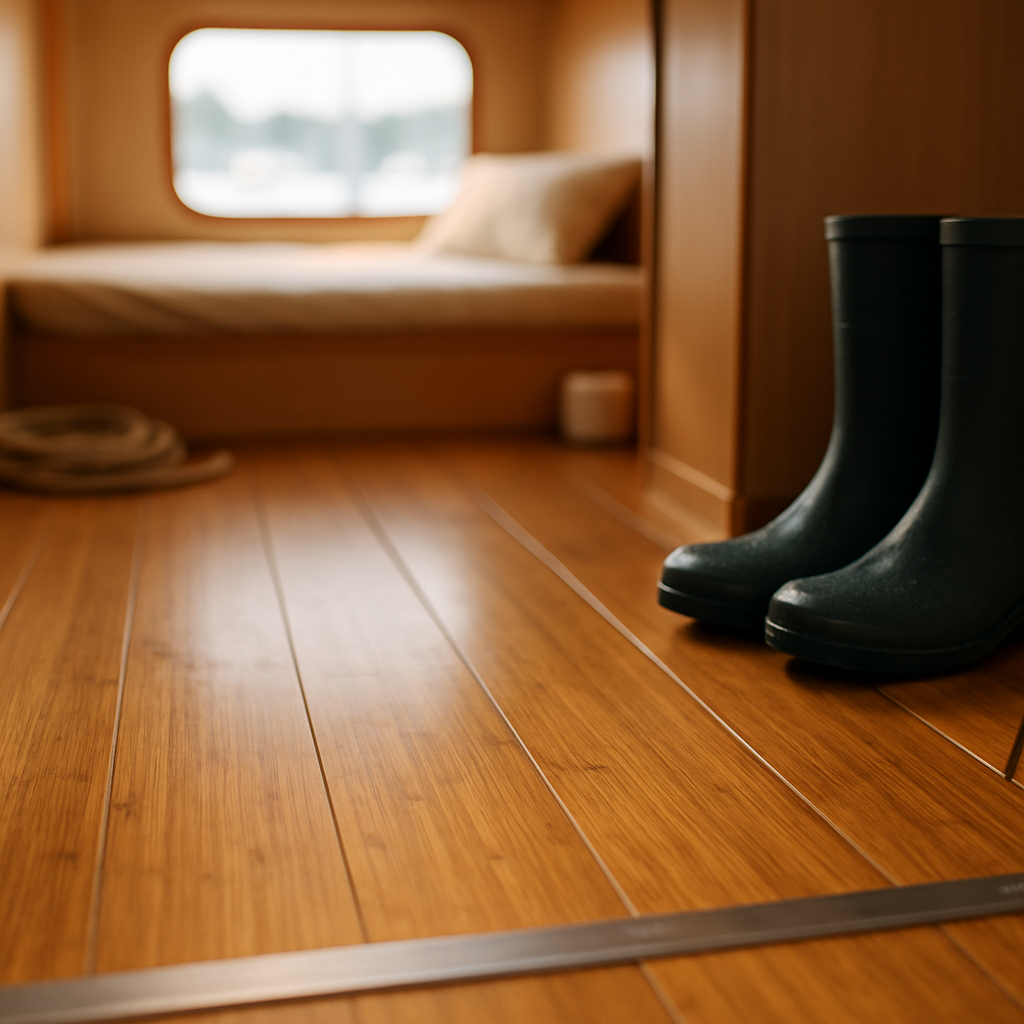
If you’re installing flooring in an area that sees wet boots, bait buckets, and surfboards, consider bamboo composites or marine-rated products at entries and wet zones. And no matter which option you choose, plan for proper installation: acclimation, vapor barriers, marine-grade adhesives, and regular maintenance are non-negotiable.
Want a quick action plan? Here’s a simple three-step approach:
- Choose engineered strand-woven bamboo with a strong factory finish.
- Install with a vapor barrier and marine-grade adhesives/underlayment.
- Maintain stable humidity, clean spills immediately, and inspect seals seasonally.
Final thought
“Bamboo Flooring Options” gives you real choices—so pick one that matches how you live aboard. With the right product, careful installation, and basic care, bamboo can deliver years of beauty, comfort, and durability on your houseboat. If you’re unsure about product specs or installation details, talk to a marine flooring pro—getting it right the first time saves time, money, and heartache later.
Ready to jump in? If you tell me your boat type, where you want the floor installed, and whether you prefer DIY or pro installation, I’ll point you to the specific Bamboo Flooring Options and installation approach that fit your project like a glove.